Air India Wants About $1.5 Billion More — Temasek’s Support Doesn’t Remove the Capital-Intensity Problem
Temasek is defending Singapore Airlines’ long-term Air India strategy even as the carrier asks its owners for more capital and SIA absorbs a large share of losses.
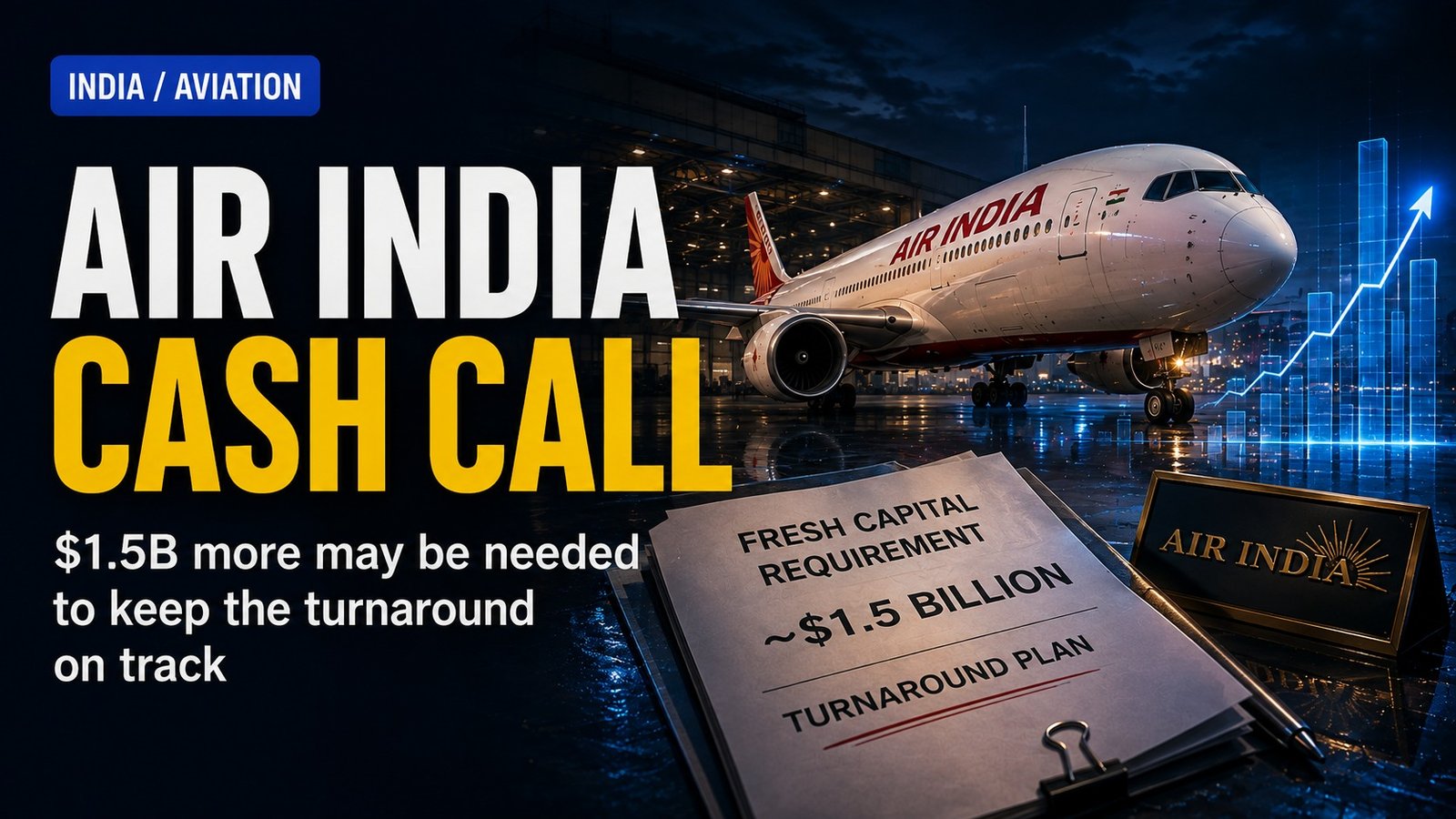
Temasek has publicly backed Singapore Airlines’ investment in Air India as scrutiny grows around the carrier’s losses and its request for roughly $1.5 billion of fresh equity from Tata Sons and SIA.
The endorsement matters because SIA owns 25.1% of Air India and calls the stake a core part of its long-term multi-hub strategy. But strategic patience does not change the financial question: how much additional capital will Air India require before its fleet, network and operating improvements produce sustainable returns?
WHAT HAPPENED
Reuters reported that Air India has asked its owners for about $1.5 billion of fresh equity. SIA’s audited FY2025/26 financial statements show a 25.1% stake in the airline, a carrying value of S$1.1346 billion at March 31 and a S$945.2 million share of Air India losses for the year.
SIA said in May that it remained committed to Air India and viewed the investment as central to a long-term multi-hub strategy. Temasek’s latest comments reinforce that strategic position rather than signalling a retreat.
WHAT EVERYONE IS WATCHING
Investors are watching whether SIA contributes its pro-rata share of the new funding.
That is only one part of the story. Air India is in a multi-year transformation involving aircraft deliveries, retrofits, network changes and service upgrades, all while dealing with elevated fuel prices, airspace constraints and supply-chain problems. The capital need therefore depends on both losses and the pace of investment.
WHAT THE MARKET MAY BE MISSING
Aviation turnarounds can create value long before reported profit turns positive if fleet quality, utilisation, on-time performance and revenue mix improve.
But they can also consume far more capital than initial estimates because aircraft, maintenance, training and working-capital requirements are front-loaded.
For SIA shareholders, the right metric is not simply “Air India loss.” It is the incremental return on every additional dollar committed to the Indian platform.
THE NUMBERS
• Fresh equity reportedly sought: about $1.5 billion • Singapore Airlines ownership: 25.1% • SIA carrying amount in Air India at Mar. 31, 2026: S$1.1346 billion • SIA FY2025/26 share of Air India losses: S$945.2 million • SIA describes Air India as core to its long-term multi-hub strategy
POSITIVE CASE
Air India improves operational reliability, premium yields and international connectivity fast enough for fresh capital to bridge a finite transformation period rather than an open-ended loss cycle.
DOWNSIDE CASE
Losses remain high while fleet and network investment continue, forcing repeated equity injections. SIA’s strategic logic could then remain valid while shareholder returns on the stake stay weak for longer.
WHAT WOULD CHANGE THE STORY
The owners’ final funding decision, Air India’s FY27 operating performance, fleet-retrofit progress, cash burn and SIA’s future equity-accounting losses will change the story.
RELATED THEMES
Air India, Singapore Airlines, Tata Sons, Temasek, Indian aviation, aircraft capex, airline turnarounds and international hubs.
PRICEVIA VIEW
Temasek’s support answers the commitment question. It does not answer the return question. The next phase is about whether fresh equity creates an operating inflection or simply extends the runway.
SOURCES & TIMESTAMP
Reuters funding and Temasek reports dated August 25 and 29; Singapore Airlines FY2025/26 official results and May 14 strategy release, accessed August 30, 2026 IST.
MARKET-RISK DISCLAIMER
For information and education only; not investment advice. Markets, regulatory outcomes, transaction terms and company guidance can change. Time-sensitive facts should be rechecked before acting.
Related PriceVia analysis

NSE’s $47 Billion IPO Could List This Month — But the Exchange Gets None of the Cash
Regulatory clearance has put a September listing in sight, but the proposed 148.9-million-share issue is entirely an offer for sale—so the money goes to existing shareholders, not NSE.

Tata Motors’ €3.82 Billion Iveco Offer Opens Tomorrow — 80% Is the Threshold That Changes the Deal
The €14.10-a-share offer has board backing and a committed 27.06% holder, but acceptance between 80% and 95% triggers a different route to control and delisting.

TCS Put ₹70,000 Crore Behind a 1-GW AI Campus — The Power Bill Is the Number Investors Need Next
HyperVault has secured 264 acres in Hyderabad for a data-centre campus of up to 1 GW, but phased demand, electricity access and utilisation will decide whether the record-scale plan earns its cost of capital.
Bharat Forge Is Bringing 70-mm Rockets to India — Early 2027 Is the Date That Decides the Story
A strategic alliance promises Indian assembly of unguided and laser-guided rockets, but the investable signal is not the announcement—it is whether technology transfer becomes qualified production on schedule.