India’s Food Labels May Turn Red — The Risk Isn’t Just Packaging Cost
FSSAI’s proposed front-of-pack red warnings could change how consumers see entire product categories, turning a health rule into a pricing and portfolio problem for packaged-food companies.
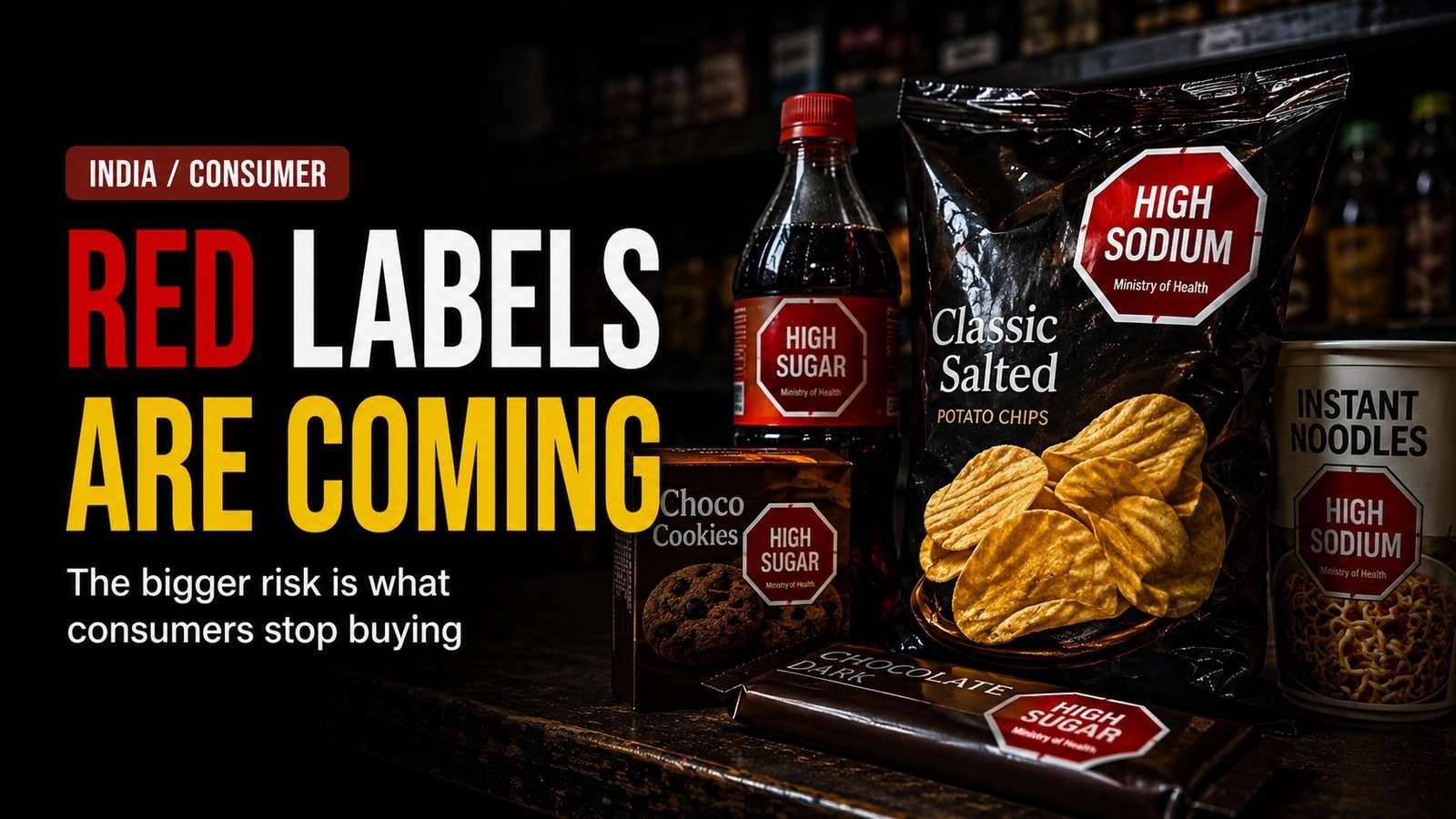
India’s packaged-food debate has moved from technical nutrition tables to something consumers can see instantly. FSSAI has told the Supreme Court it is proposing red hexagonal front-of-pack warnings for products high in specified levels of sugar, saturated fat or salt.
That sounds like a labelling story. For listed food and beverage companies, it is really a demand-elasticity story: if a bright warning moves purchasing behaviour even slightly, companies may need to reformulate products, change pack sizes, alter promotions or accept pressure on high-margin categories.
WHAT HAPPENED
The proposal described in FSSAI’s Supreme Court filing would use prominent red warnings such as “HIGH FAT,” “HIGH SUGAR,” “HIGH SALT” and “HIGHLY SWEETENED BEVERAGE.” Reports on the affidavit say the framework would apply to products meeting specified nutrient thresholds, with implementation phased and some exemptions.
The move follows Supreme Court criticism of delays and a public debate over whether interpretive warnings are more useful than numeric nutrition information alone.
WHAT EVERYONE IS WATCHING
The first market question is which major brands would trigger one or more warnings.
The more useful question is what companies do next. Reformulation can protect brand perception but may change taste, input costs and consumer acceptance. Keeping the formulation unchanged may protect the product experience but expose the brand to a visible negative signal at the exact moment a consumer is choosing between alternatives.
WHAT THE MARKET MAY BE MISSING
The effect may be uneven across price points. Premium brands can sometimes absorb reformulation costs or use health positioning to defend margins. Mass-market brands may have less room to raise prices and more sensitivity to taste changes.
There is also a portfolio effect: companies with a broad mix of staples, nutrition, dairy and lower-sugar products may manage the transition better than businesses concentrated in sweetened beverages, salty snacks or highly processed categories.
THE NUMBERS
• Proposed format: red hexagonal front-of-pack warnings • Disclosures reported: HIGH FAT, HIGH SUGAR, HIGH SALT and/or HIGHLY SWEETENED BEVERAGE • Trigger concept: products high in specified nutrients of concern • Supreme Court scrutiny has accelerated the policy timetable • Final thresholds and implementation details are not yet the same as a notified final rule
POSITIVE CASE
Clear rules could reward companies that already invested in lower-sugar, lower-salt or portion-controlled portfolios. Reformulation may also create new premium “better-for-you” categories.
DOWNSIDE CASE
If warning coverage is broad, heavily exposed brands could face reformulation costs, weaker volumes or higher promotional spending. Industry litigation or prolonged consultation could also create uncertainty without resolving the eventual cost.
WHAT WOULD CHANGE THE STORY
The final FSSAI notification, nutrient thresholds, exemptions, transition period and company-specific reformulation plans will determine the earnings impact.
RELATED THEMES
Packaged foods, beverages, Nestlé India, Britannia, Tata Consumer, Varun Beverages, PepsiCo/Coca-Cola ecosystem, consumer health and food regulation.
PRICEVIA VIEW
The label itself is cheap. The expensive part is the consumer response. Investors should map revenue by product category before treating this as a simple compliance expense.
SOURCES & TIMESTAMP
Reuters, ThePrint and LiveLaw reports on FSSAI’s Supreme Court affidavit published August 28–29, accessed August 29, 2026 IST.
MARKET-RISK DISCLAIMER
For information and education only; not investment advice. Markets, regulatory decisions and transaction terms can change, and investors should verify time-sensitive information before acting.
Related PriceVia analysis

NSE’s $47 Billion IPO Could List This Month — But the Exchange Gets None of the Cash
Regulatory clearance has put a September listing in sight, but the proposed 148.9-million-share issue is entirely an offer for sale—so the money goes to existing shareholders, not NSE.

Tata Motors’ €3.82 Billion Iveco Offer Opens Tomorrow — 80% Is the Threshold That Changes the Deal
The €14.10-a-share offer has board backing and a committed 27.06% holder, but acceptance between 80% and 95% triggers a different route to control and delisting.

TCS Put ₹70,000 Crore Behind a 1-GW AI Campus — The Power Bill Is the Number Investors Need Next
HyperVault has secured 264 acres in Hyderabad for a data-centre campus of up to 1 GW, but phased demand, electricity access and utilisation will decide whether the record-scale plan earns its cost of capital.

Bharat Forge Is Bringing 70-mm Rockets to India — Early 2027 Is the Date That Decides the Story
A strategic alliance promises Indian assembly of unguided and laser-guided rockets, but the investable signal is not the announcement—it is whether technology transfer becomes qualified production on schedule.