India May Cut Cooking-Oil Duties — Global Prices Could Buy Back the Relief
New Delhi is considering a five-percentage-point tax reduction after edible-oil prices climbed nearly 20%, but the consumer benefit depends on global prices, the rupee and whether importers pass the saving through.
India May Cut Cooking-Oil Duties — Global Prices Could Buy Back the Relief
*By PriceVia Macro Desk | Published September 17, 2026 | Updated September 17, 2026*
Why this matters now
New Delhi is considering a five-percentage-point tax reduction after edible-oil prices climbed nearly 20%, but the consumer benefit depends on global prices, the rupee and whether importers pass the saving through.
Key points
- India is considering lowering the basic import duty on vegetable oils by five percentage points. - Cooking-oil prices have risen nearly 20%, making food inflation and household budgets the immediate policy concern. - India imports roughly two-thirds of its edible-oil needs, so foreign prices and currency moves can overwhelm a domestic tax change.
The numbers
| Metric | Value | Context | |---|---:|---| | Possible duty cut | 5 percentage points | Basic import duty | | Price increase | Nearly 20% | Cooking oils | | Import dependence | About two-thirds | Domestic consumption | | Current basic duty | 10% | Crude edible oils | | Effective levy | 16.5% | Including cesses | | Policy date | September 17 | Decision not yet final |
What happened — confirmed facts
Reuters reported that officials are considering a five-point reduction in the basic customs duty on vegetable oils after retail cooking-oil prices rose sharply. No final notification had been issued at publication, so the proposal must not be treated as an enacted tax change. [S1, S2] India is the world’s largest vegetable-oil importer and buys palm, soybean and sunflower oil from overseas. That import dependence means landed costs also respond to benchmark prices, freight and the rupee, while domestic oilseed growers are exposed to cheaper imports. [S1, S3]
What everyone is watching
Consumers will watch shelf prices, but the first signal appears in landed import costs and wholesale quotes. A five-point tax saving is not automatically a five-point retail cut because inventories, refining margins, packaging and distribution sit between customs and the kitchen. Policymakers must balance faster inflation relief against farm incentives. A large cut can help urban and low-income households now, yet it may weaken prices received by domestic oilseed producers just as India wants to reduce structural import dependence.
What the market may be missing — PriceVia analysis
PriceVia analysis: the decision is best read as an inflation transmission test, not a simple tax giveaway. If brands retain the saving or global prices rise again, the visible relief can be much smaller than the headline duty move. The overlooked variable is timing. Importers holding higher-cost inventory may pass through relief slowly, while firms contracting new cargoes after the notification could see benefits first. Weekly retail and wholesale spreads will reveal who captures the cut.
Positive case
Global edible-oil prices cool, the rupee holds steady and competition forces brands to pass most of the tax saving to consumers. Food inflation eases without a severe fall in domestic oilseed prices.
Downside case
A fresh rally in palm or soybean oil, currency weakness or limited pass-through absorbs the duty benefit. Farmers then face cheaper imports while households see little durable relief.
What would change the story
A signed customs notification, lower landed-cost data and broad retail price cuts would convert the proposal into measurable relief. A global supply shock or weaker rupee would reverse that reading.
Related stocks and themes
Edible-oil refiners, FMCG companies, palm and soybean importers, oilseed farmers, the rupee, food inflation and household consumption.
How to read it
Wait for the notification, compare landed and retail prices, and separate temporary inventory effects from a sustained margin or inflation change.
Reader checklist
- Confirm customs notification in a primary disclosure before changing the thesis. - Compare retail pass-through with the headline narrative; they may move in different directions. - Reassess after new information on global edible-oil prices rather than treating the first report as a completed outcome.
PriceVia View
The tax lever can soften the shock, but it cannot control the world price. Track the retail pass-through rather than assuming the announced percentage lands fully in household wallets.
Sources and timestamps
- [S1 — Reuters: India considers vegetable-oil duty cut](https://www.reuters.com/world/india/india-considers-cutting-vegetable-oil-import-taxes-prices-climb-2026-09-16/) — published 2026-09-16; accessed 2026-09-17T13:15:00+05:30 - [S2 — Department of Revenue customs notifications](https://dor.gov.in/customs-notifications) — published 2026-09-17; accessed 2026-09-17T13:15:00+05:30 - [S3 — Department of Consumer Affairs price monitoring](https://fcainfoweb.nic.in/) — published 2026-09-17; accessed 2026-09-17T13:15:00+05:30 - [S4 — Ministry of Agriculture oilseeds information](https://agriwelfare.gov.in/) — published 2026-09-17; accessed 2026-09-17T13:15:00+05:30
Visual disclosure
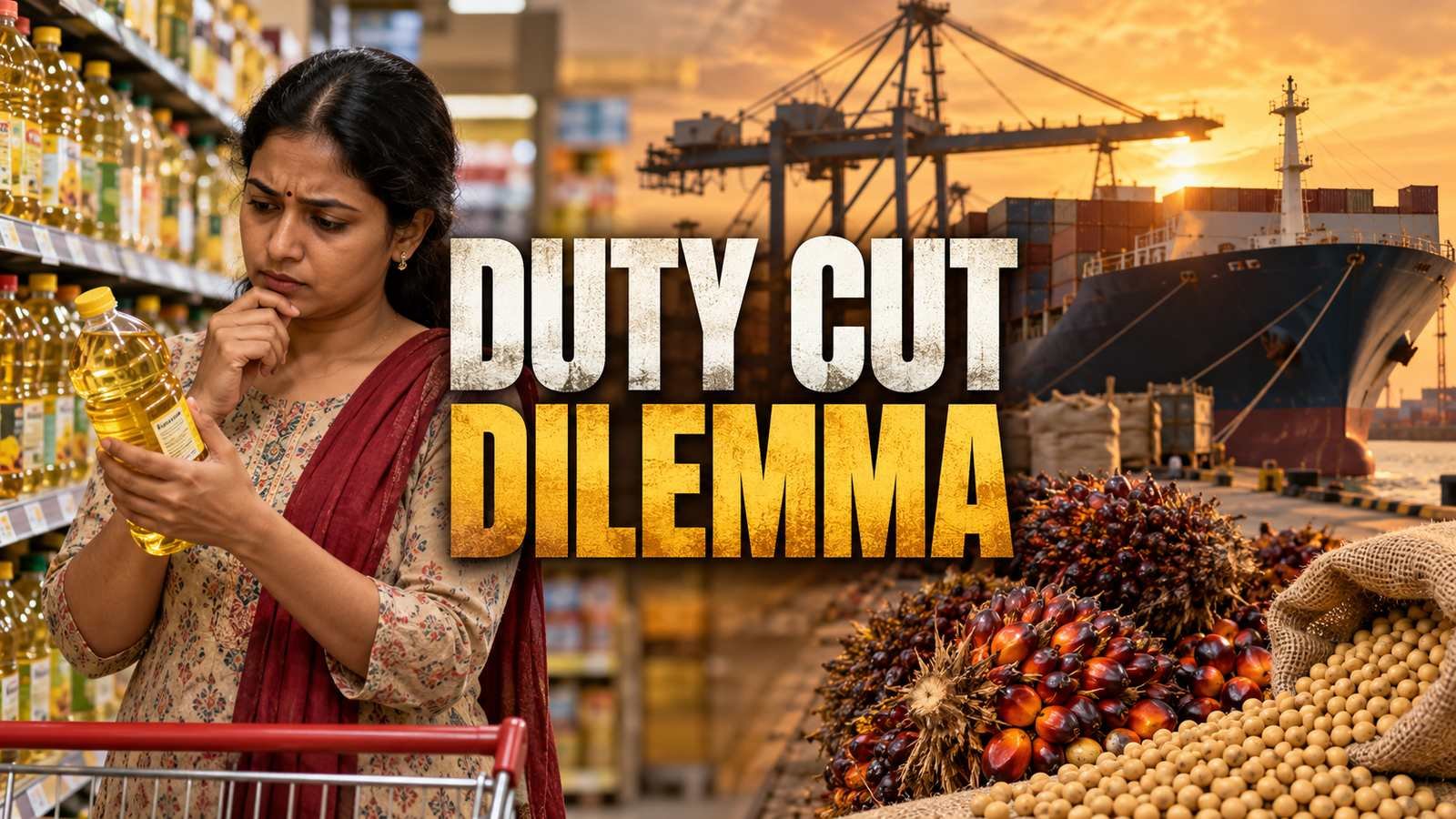
Hero visual created specifically for this article. Thumbnail text: “DUTY CUT DILEMMA”. It is an editorial illustration, not a market-data, legal or regulatory screenshot.
Market-risk disclaimer
This article is for market education and information only. It is not investment advice, a recommendation or a promise of returns. Market prices, policy decisions, deal terms and forecasts can change. Verify the latest primary disclosures and assess suitability and risk independently.
- Customs notification
- Retail pass-through
- Global edible-oil prices
Risk context: This article is for market education and information only. It is not investment advice, a recommendation or a promise of returns. Market prices, policy decisions, deal terms and forecasts can change. Verify the latest primary disclosures and assess suitability and risk independently.
- reuters.com2026-09-16
- dor.gov.in2026-09-17
- fcainfoweb.nic.in2026-09-17
- agriwelfare.gov.in2026-09-17
Related PriceVia analysis
Delhi Metro Carried a Record 82.45 Lakh Riders in One Day — A Bus Strike Revealed Its Spare Capacity
A sudden DTC bus disruption pushed Delhi Metro to a new daily record, testing whether the network can absorb shocks without letting reliability deteriorate.

Tessolve Wants $500 Million of Revenue in Four Years — Two Acquisitions Could Decide the Semiconductor Services Race
The Hero Electronix-owned chip engineering specialist is evaluating two purchases as it tries to scale from design and testing into a larger global semiconductor-services platform.
India Gave Compressed Biogas an Assured Buyer — Price Support Could Finally Turn Waste Into Bankable Fuel
New GOBARdhan rules address the two questions that have stalled many waste-to-gas projects: who will buy the output and how predictable will the price be.

India's New ESG Assurance Standard Starts in April 2027 — Two Big Carve-Outs Will Shape What Investors Can Trust
SSA 5000 broadens assurance across climate, labour and biodiversity disclosures, but excludes joint audits and forward-looking statements from the international framework.