One in Five Food Samples Failed India’s Safety Test — The Crackdown Is Becoming a Business Risk
Raids, licence cancellations and a front-of-pack label battle are shifting food safety from a compliance footnote to a valuation issue for restaurants, brands and quick commerce.
One in Five Food Samples Failed India’s Safety Test — The Crackdown Is Becoming a Business Risk
**Raids, licence cancellations and a front-of-pack label battle are shifting food safety from a compliance footnote to a valuation issue for restaurants, brands and quick commerce.**
*By PriceVia Business Desk | Published September 9, 2026 | Updated September 9, 2026*
Why this matters now
Raids, licence cancellations and a front-of-pack label battle are shifting food safety from a compliance footnote to a valuation issue for restaurants, brands and quick commerce.
Key points
- Roughly 20% of food samples tested annually since 2020 were unsafe, substandard or mislabelled, according to government data cited by Reuters. - Nearly 8,000 food licences were revoked over three years as state enforcement intensified. - Front-of-pack warnings could change product recipes, packaging economics and consumer perception across a $100 billion industry.
The numbers
| Metric | Value | Context | |---|---:|---| | Samples failing | ~1 in 5 | Annual tests since 2020 | | Licences revoked | ~8,000 | Past 3 years | | Maharashtra raids | 3,000+ | Reported campaign | | Industry size | $100bn | Packaged food estimate | | Fanta sugar gap | 3× | India versus UK example | | Label shape proposed | Red hexagon | Front-of-pack debate |
What happened
Indian authorities are escalating raids, shutdowns and licence action against food businesses as public concern over adulteration and hygiene grows. Government figures reviewed by Reuters indicate roughly one in five samples tested annually since 2020 was unsafe, substandard or mislabelled, while nearly 8,000 licences were revoked over three years. [S1, S2] At the same time, the fight over front-of-pack warnings has reached the courts. Regulators have considered a red-hexagon warning for products high in sugar, salt or fat. Health advocates argue for clearer warnings; food companies worry about design, thresholds and the commercial effect on familiar brands. [S1, S3]
What everyone is watching
The immediate focus is enforcement consistency. Raids generate headlines, but durable change requires accredited testing, traceable evidence, prompt adjudication and comparable standards across states. Companies need to know whether a violation leads to correction, recall, licence suspension or permanent closure. Large packaged-food companies are also watching the final labelling rule. A prominent warning can influence purchase decisions and encourage reformulation, but implementation time, serving-size definitions and treatment of small packages determine the real cost.
What the market may be missing
PriceVia analysis: this is becoming a supply-chain and platform-liability story. Quick-commerce warehouses, restaurants, private labels and aggregators all depend on reliable expiry dates, storage temperatures and supplier documents. Faster delivery increases the value of traceability because a bad batch can spread before manual checks catch it. Stronger enforcement can ultimately favour organised players with testing budgets and auditable sourcing. The transition, however, may expose hidden costs: discarded inventory, packaging redesign, franchise monitoring, recalls and lost shelf space. Brand trust can fall faster than a factory can reformulate.
Positive case
Clear national standards reward companies that invest early in laboratories, cold chains and traceability. Reformulation improves products, compliant operators gain share from informal rivals and consumer confidence expands the addressable market.
Downside case
Rules remain contested or unevenly enforced, creating legal cost without predictable outcomes. A major recall or export rejection damages a brand, while smaller suppliers pass higher compliance expense through to food inflation.
What would change the story
Watch the Supreme Court proceedings, FSSAI’s final label design, transition deadlines, state testing data, recall notices and company reformulation plans. A uniform rulebook with published enforcement outcomes would reduce uncertainty; repeated court delays would prolong it.
Related stocks and themes
Packaged food, restaurant chains, quick commerce, cold storage, testing laboratories, packaging suppliers, ingredient companies, consumer staples and product-liability insurance.
PriceVia View
The investable issue is no longer whether consumers care about safety; enforcement is giving that concern financial consequences. Companies with clean sourcing and rapid traceability may turn compliance from a cost into a competitive advantage.
Sources and timestamps
- [S1 — Reuters: raids, closures and warning-label debate](https://www.reuters.com/legal/litigation/raids-shutdowns-warning-labels-indias-unprecedented-food-safety-push-2026-09-08/) — published 2026-09-08; accessed 2026-09-09T08:15:00+05:30 - [S2 — Reuters: inside India’s food-safety crackdown](https://www.reuters.com/world/india/inside-indias-food-safety-crackdown-2026-09-08/) — published 2026-09-08; accessed 2026-09-09T08:15:00+05:30 - [S3 — FSSAI: labelling and display regulations](https://www.fssai.gov.in/cms/food-safety-and-standards-regulations.php) — published accessed 2026-09-09; accessed 2026-09-09T08:15:00+05:30 - [S4 — Supreme Court of India: February 2026 food-labelling order](https://api.sci.gov.in/supremecourt/2025/35988/35988_2025_6_12_68509_Order_10-Feb-2026.pdf) — published 2026-02-10; accessed 2026-09-09T08:15:00+05:30
Visual disclosure
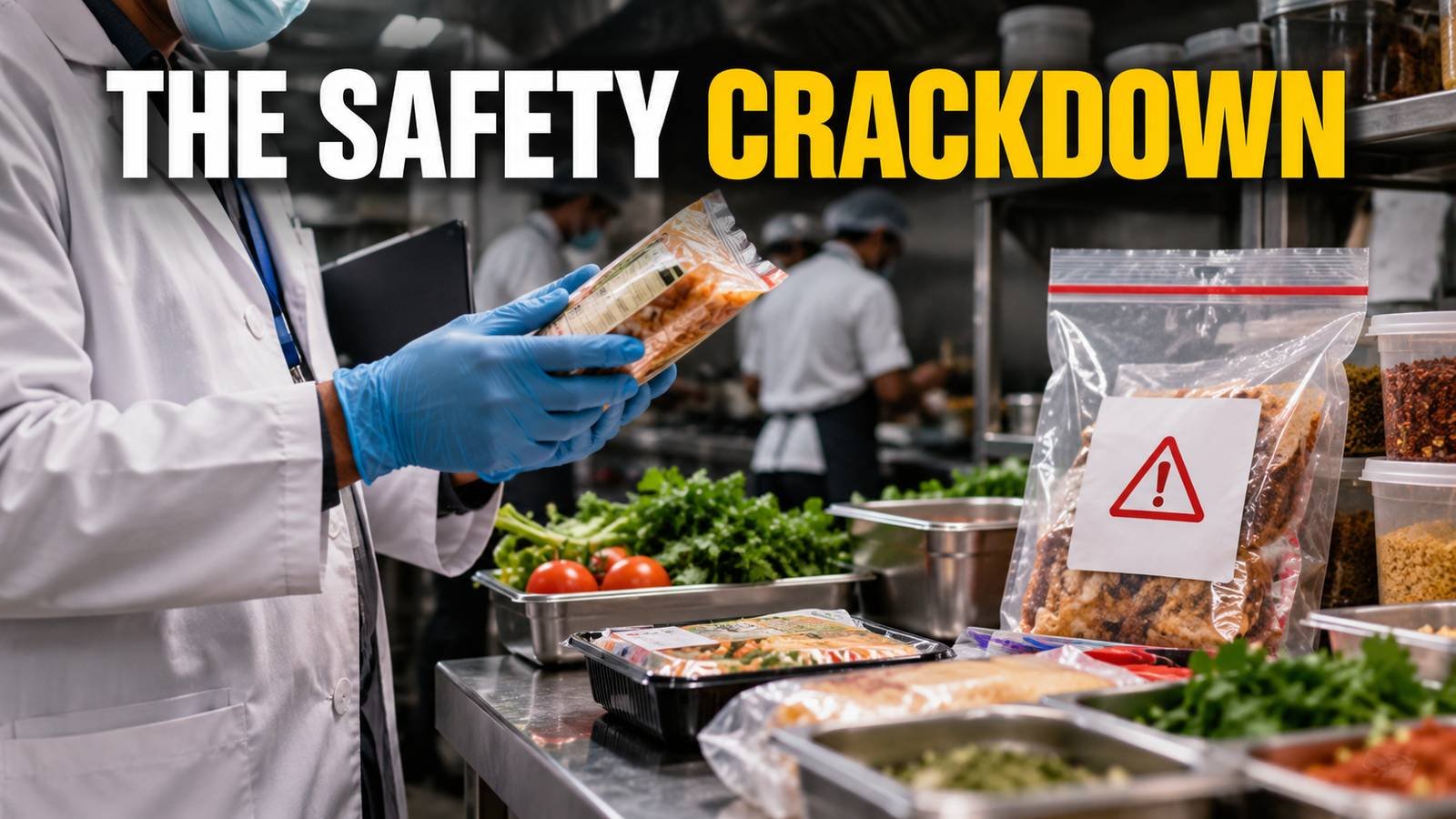
Hero visual created specifically for this article. Thumbnail text: “THE SAFETY CRACKDOWN”. It is an editorial illustration, not a market-data screenshot.
Market-risk disclaimer
This article is for market education and information only. It is not investment advice, a recommendation, or a promise of returns. Prices, transaction terms, approvals, company plans and regulations can change; verify the latest primary disclosures and assess risk independently.
- Supreme Court review
- Final warning-label rule
- Recall and licence data
Risk context: This article is for market education and information only. It is not investment advice, a recommendation, or a promise of returns. Prices, transaction terms, approvals, company plans and regulations can change; verify the latest primary disclosures and assess risk independently.
- reuters.com2026-09-08
- reuters.com2026-09-08
- fssai.gov.inaccessed 2026-09-09
- api.sci.gov.in2026-02-10
Related PriceVia analysis

AI Leaders Asked for a Slowdown — Zuckerberg Said Competition Is Safer Than Coordination
Meta’s chief says liability and rivalry already force responsible development, breaking with peers who support a pause on recursive self-improvement; antitrust now sits inside the safety debate.

New York Put a $1 Million Price on Every Data-Center Megawatt
The state wants host communities to receive at least $1 million for each megawatt of utility demand, turning power consumption into a direct development cost for AI infrastructure.

Tesla Put Cybercabs on Austin Roads — The Regulator Wants to Know Which Rules They Passed
Tesla must answer by September 30 whether temporary human controls supported certification of a robotaxi that lacks a steering wheel, pedals and mirrors; deployment moved faster than rulemaking.

Japan Is Taking Rates to a 31-Year High — The Cheap-Yen Trade Is Losing Its Anchor
A likely 25-basis-point increase would put the BOJ rate at 1.25% and near its neutral range; the global consequence is a less dependable funding currency for leveraged trades.