India Opened a 654-MW Power Lifeline to Nepal — Solar Hours Explain the Limit
Flood damage forced hydropower-dependent Nepal from exporter to emergency importer; India can cover 18 hours a day through two links, revealing both the strength of daytime solar and the weakness of the evening grid.
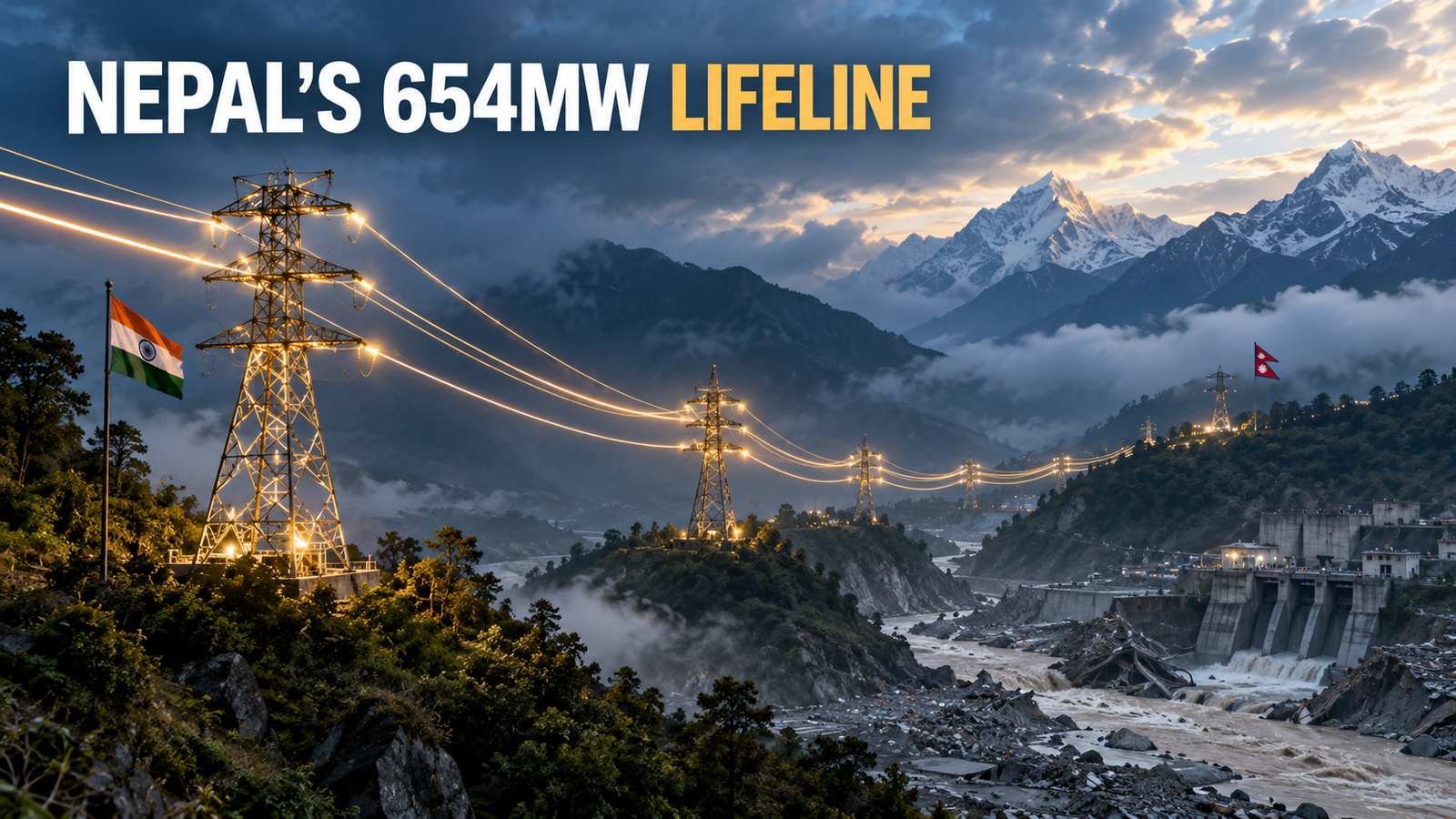
India Opened a 654-MW Power Lifeline to Nepal — Solar Hours Explain the Limit
*By PriceVia Infrastructure Desk | Published September 15, 2026 | Updated September 15, 2026*
Why this matters now
Flood damage forced hydropower-dependent Nepal from exporter to emergency importer; India can cover 18 hours a day through two links, revealing both the strength of daytime solar and the weakness of the evening grid.
Key points
- India approved exports of up to 654 MW to Nepal for 18 hours daily through December 31. - The plan includes up to 600 MW through Muzaffarpur–Dhalkebar and 54 MW through Tanakpur–Mahendranagar. - Supply is concentrated from midnight to 6 p.m.; India’s own evening demand prevents a full 24-hour commitment.
The numbers
| Metric | Value | Context | |---|---:|---| | Maximum export | 654 MW | Two cross-border links | | Daily window | 18 hours | Midnight to 6 p.m. | | Main corridor | 600 MW | Muzaffarpur–Dhalkebar | | Second corridor | 54 MW | Tanakpur–Mahendranagar | | Current approval | Through Dec. 31 | Review expected | | India peak demand | 269 GW | Reported September record |
What happened — confirmed facts
India approved Nepal’s request for emergency electricity after a glacier-triggered flood damaged more than a dozen hydropower facilities and disrupted the country’s power system. The approval runs through December 31. [S1, S2] Exports are permitted for 18 hours each day, with up to 600 MW on the Muzaffarpur–Dhalkebar line and 54 MW on the Tanakpur–Mahendranagar line. The missing evening hours reflect tight Indian supply after solar output fades. [S2, S3]
What everyone is watching
Grid operators must balance humanitarian support with domestic reliability. Daytime solar surplus can help Nepal, while India’s evening peak still requires coal, gas, storage and demand management. Nepal’s reconstruction timetable matters. Temporary imports protect essential services, but long-term energy security depends on restoring generation and making mountain infrastructure more resilient to extreme weather.
What the market may be missing — PriceVia analysis
PriceVia analysis: the 18-hour design is a live demonstration of solar’s shape. India can export when panels produce, yet struggles to extend the same volume through the evening without flexible capacity. Cross-border grids are climate insurance. Interconnection allows neighbours to share shocks, but it also creates financial and operational questions about pricing, settlement, congestion and emergency priority.
Positive case
Transmission remains stable, India’s daytime surplus covers Nepal’s gap and damaged plants return on schedule. The emergency arrangement deepens regional power-market cooperation.
Downside case
Further damage, transmission failure or a severe Indian evening shortage leaves Nepal with rotating outages. Reconstruction costs and lost power exports could strain Nepal’s fiscal position.
What would change the story
Watch daily schedules, transmission availability, Nepal’s plant-restoration milestones, December review and battery or flexible-generation additions. A 24-hour arrangement would signal more balancing capacity.
Related stocks and themes
Indian power exchanges, NTPC, Power Grid, hydropower, solar curtailment, battery storage, Nepal Electricity Authority and regional transmission.
How to read it
Track the event as an infrastructure and balancing signal, not simply an export-volume story. Storage and transmission gain strategic value when climate shocks hit hydro systems.
Reader checklist
- Confirm daily schedules in a primary disclosure before changing the thesis. - Compare plant restoration with the headline narrative; they may move in different directions. - Reassess after new information on december review rather than treating the first report as a completed outcome.
PriceVia View
The headline is emergency solidarity; the grid lesson is flexibility. Electricity is available for 18 hours because generation and demand do not line up for 24.
Sources and timestamps
- [S1 — Reuters: India approves Nepal power exports](https://www.reuters.com/business/energy/india-approves-export-power-nepal-after-deadly-flood-2026-09-14/) — published 2026-09-14; accessed 2026-09-15T13:15:00+05:30 - [S2 — Indian Express: 18-hour supply details](https://indianexpress.com/article/business/india-approves-18-hour-power-supply-to-nepal-amid-hydropower-losses-10877556/) — published 2026-09-14; accessed 2026-09-15T13:15:00+05:30 - [S3 — Ministry of Power: cross-border electricity](https://powermin.gov.in/) — published 2026-09-15; accessed 2026-09-15T13:15:00+05:30 - [S4 — Nepal Electricity Authority](https://www.nea.org.np/) — published 2026-09-15; accessed 2026-09-15T13:15:00+05:30
Visual disclosure
Hero visual created specifically for this article. Thumbnail text: “NEPAL'S 654MW LIFELINE”. It is an editorial illustration, not a market-data, legal, clinical or regulatory screenshot.
Market-risk disclaimer
This article is for market education and information only. It is not investment advice, a recommendation or a promise of returns. Market prices, policy decisions, deal terms, clinical results and forecasts can change. Verify the latest primary disclosures and assess suitability and risk independently.
- Daily schedules
- Plant restoration
- December review
Risk context: This article is for market education and information only. It is not investment advice, a recommendation or a promise of returns. Market prices, policy decisions, deal terms, clinical results and forecasts can change. Verify the latest primary disclosures and assess suitability and risk independently.
- reuters.com2026-09-14
- indianexpress.com2026-09-14
- powermin.gov.in2026-09-15
- nea.org.np2026-09-15
Related PriceVia analysis

AI Leaders Asked for a Slowdown — Zuckerberg Said Competition Is Safer Than Coordination
Meta’s chief says liability and rivalry already force responsible development, breaking with peers who support a pause on recursive self-improvement; antitrust now sits inside the safety debate.
New York Put a $1 Million Price on Every Data-Center Megawatt
The state wants host communities to receive at least $1 million for each megawatt of utility demand, turning power consumption into a direct development cost for AI infrastructure.

Tesla Put Cybercabs on Austin Roads — The Regulator Wants to Know Which Rules They Passed
Tesla must answer by September 30 whether temporary human controls supported certification of a robotaxi that lacks a steering wheel, pedals and mirrors; deployment moved faster than rulemaking.

Japan Is Taking Rates to a 31-Year High — The Cheap-Yen Trade Is Losing Its Anchor
A likely 25-basis-point increase would put the BOJ rate at 1.25% and near its neutral range; the global consequence is a less dependable funding currency for leveraged trades.