India Signed for Javelin Missiles — The Bigger Option Is What Could Be Built in India Next
The immediate procurement modernises anti-armour capability, but the strategically larger question is whether the purchase becomes a bridge to joint production and a deeper defence-industrial relationship.
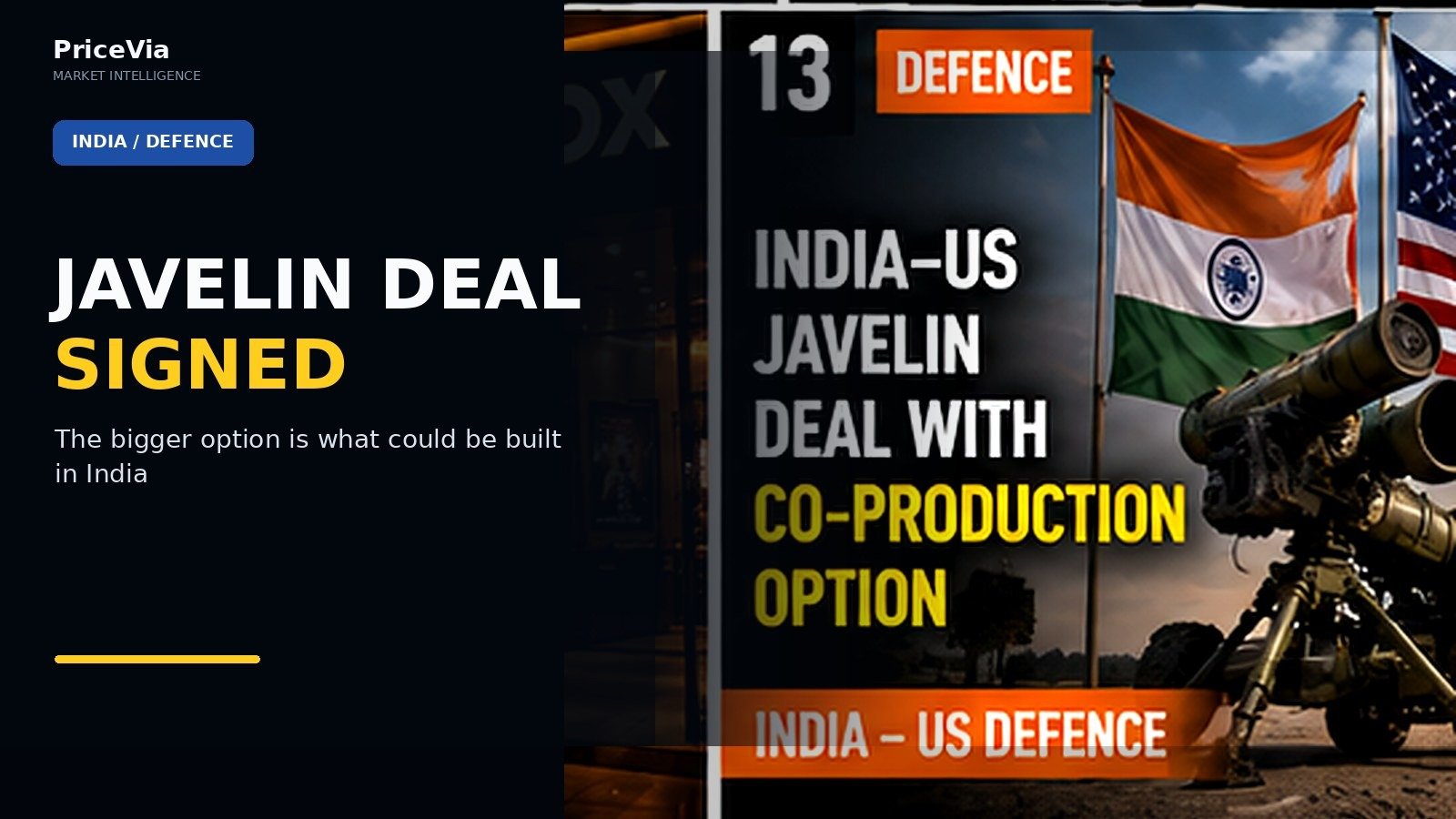
India has signed a Letter of Offer and Acceptance with the United States for Javelin anti-tank guided missile systems for the Indian Army.
The procurement itself matters, but the market-relevant industrial angle is larger. U.S. and Indian officials are explicitly linking the purchase to potential future cooperation between defence industries, including the possibility of joint production in India.
WHAT HAPPENED
Reuters reported that the Indian Army finalised the agreement for Javelin systems, while the U.S. Embassy welcomed the signing.
Akashvani, citing the embassy, said both countries are working toward eventual joint production in India. The immediate deal is therefore best understood as a procurement step with an industrial-policy option attached.
WHAT EVERYONE IS WATCHING
The first question is how many missiles and launch units India buys.
For defence-industry investors, the bigger question is local content. A future production arrangement could involve Indian private or public-sector partners, component suppliers, assembly, testing and maintenance — creating a much wider economic footprint than the initial import.
WHAT THE MARKET MAY BE MISSING
Defence imports can be strategic bridge assets.
India has increasingly used foreign purchases to accelerate capability while negotiating local manufacturing and technology partnerships. The value of the Javelin deal will therefore depend partly on whether co-production becomes specific, contracted and economically meaningful.
Until then, investors should not assume local manufacturing revenue from a statement of intent.
THE NUMBERS
• Agreement: Letter of Offer and Acceptance signed • System: Javelin anti-tank guided missile • Customer: Indian Army • Procurement route: government-to-government U.S. defence cooperation • Future possibility discussed by officials: joint production in India • Detailed quantity/value in Reuters’s initial report: not disclosed
POSITIVE CASE
India converts the purchase into a local manufacturing programme with meaningful Indian content, creating recurring production, support and export opportunities.
DOWNSIDE CASE
Co-production remains aspirational, most value stays with overseas suppliers and the initial order has limited impact on listed Indian defence manufacturers.
WHAT WOULD CHANGE THE STORY
Disclosure of quantities, contract value, Indian industrial partners, local-content requirements and any production agreement will determine whether the industrial option becomes real.
RELATED THEMES
Indian Army, Javelin, U.S.-India defence cooperation, Bharat Dynamics, private defence suppliers, anti-tank weapons and Make in India.
PRICEVIA VIEW
The immediate purchase upgrades capability. The investable story starts only when “future co-production” becomes a named partner, a factory scope and a contract value.
SOURCES & TIMESTAMP
Reuters August 28 report and Government of India Akashvani confirmation published August 29, accessed August 30 IST.
MARKET-RISK DISCLAIMER
For information and education only; not investment advice. Markets, regulatory outcomes, transaction terms and company guidance can change. Time-sensitive facts should be rechecked before acting.
Related PriceVia analysis

NSE’s $47 Billion IPO Could List This Month — But the Exchange Gets None of the Cash
Regulatory clearance has put a September listing in sight, but the proposed 148.9-million-share issue is entirely an offer for sale—so the money goes to existing shareholders, not NSE.

Tata Motors’ €3.82 Billion Iveco Offer Opens Tomorrow — 80% Is the Threshold That Changes the Deal
The €14.10-a-share offer has board backing and a committed 27.06% holder, but acceptance between 80% and 95% triggers a different route to control and delisting.

TCS Put ₹70,000 Crore Behind a 1-GW AI Campus — The Power Bill Is the Number Investors Need Next
HyperVault has secured 264 acres in Hyderabad for a data-centre campus of up to 1 GW, but phased demand, electricity access and utilisation will decide whether the record-scale plan earns its cost of capital.
Bharat Forge Is Bringing 70-mm Rockets to India — Early 2027 Is the Date That Decides the Story
A strategic alliance promises Indian assembly of unguided and laser-guided rockets, but the investable signal is not the announcement—it is whether technology transfer becomes qualified production on schedule.