U.S. Treasury Expands Long-Dated Bond Buybacks to Calm a Stressed Market
The U.S. Treasury has moved to increase buybacks of long-dated government bonds after a sharp rise in yields unsettled one of the world's most important financial markets. The change doubles the size of certain repurchase operations from $2 billion to at least $4 billion per transaction for selected maturities between 10 and 30 years.
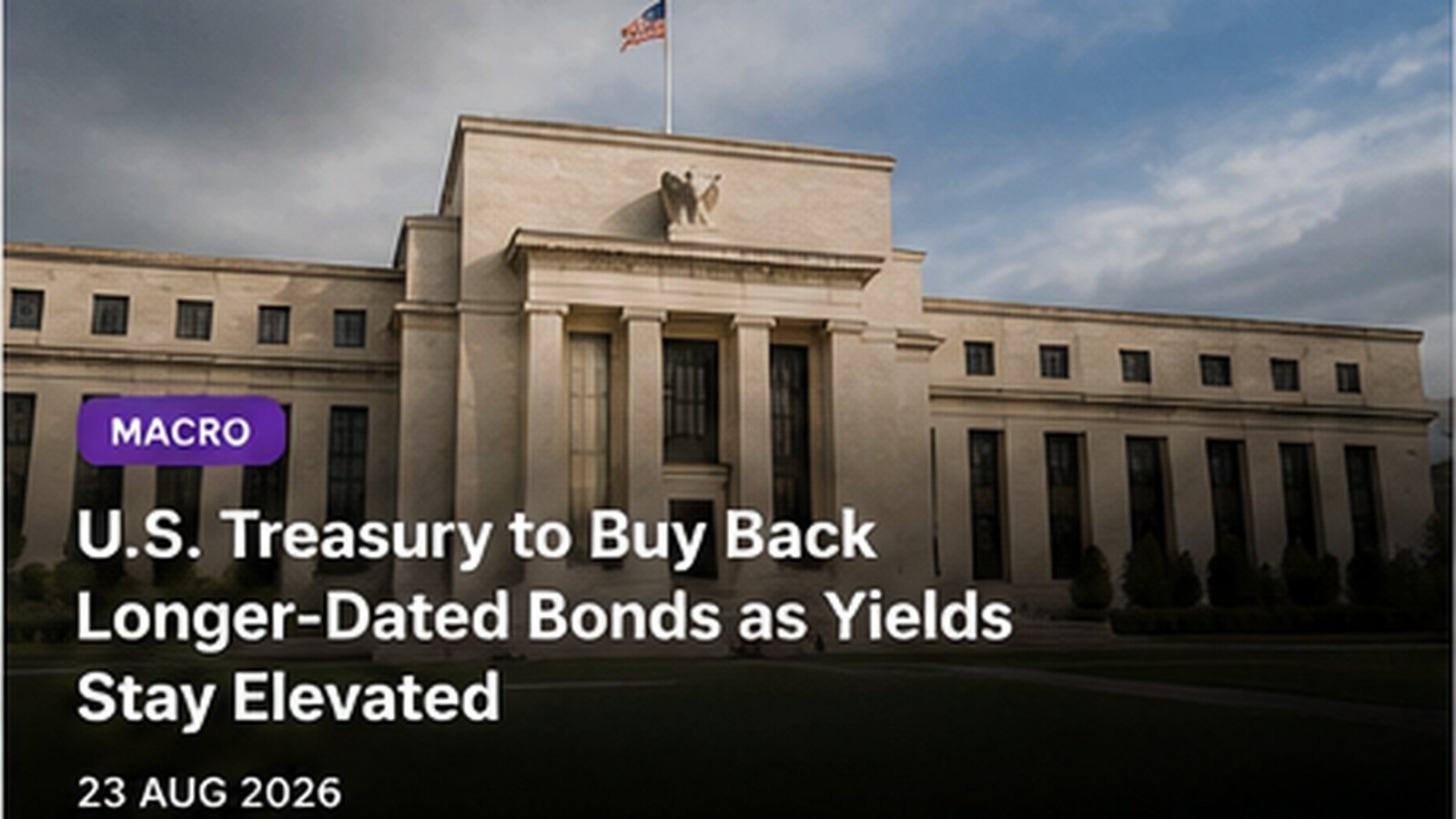
The U.S. Treasury has moved to increase buybacks of long-dated government bonds after a sharp rise in yields unsettled one of the world's most important financial markets. The change doubles the size of certain repurchase operations from $2 billion to at least $4 billion per transaction for selected maturities between 10 and 30 years.
The timing is significant because long-term Treasury yields had climbed rapidly, with the 30-year yield recently reaching 5.34%, its highest level since 2007. High long-end yields affect far more than government borrowing. They influence mortgage rates, corporate financing, equity valuations and the discount rate used across global asset markets.
Treasury buybacks are designed primarily as a market-functioning tool. By repurchasing older or less-liquid securities, the department can improve liquidity in specific parts of the curve and reduce pricing distortions. The policy should not be confused with Federal Reserve quantitative easing. The Treasury is managing the composition and liquidity of outstanding debt, not setting monetary policy.
Even so, markets care because the scale and timing of Treasury operations can influence financial conditions. If investors become worried that the supply of long-dated debt is too large relative to demand, yields can rise quickly. Buybacks can soften that stress at the margin, although they do not solve the fiscal drivers behind heavy government borrowing.
This distinction is central to understanding the move. A $4 billion operation is meaningful for liquidity in a targeted sector, but small relative to the overall Treasury market. Investors are therefore likely to keep focusing on deficits, debt-service costs, inflation expectations and future issuance.
The cross-asset reaction also matters. A decline in long yields or a weaker dollar can support equities, gold and cryptocurrencies. Conversely, if yields resume their climb despite larger buybacks, risk assets may again face pressure from tighter financial conditions.
For Indian markets, the U.S. long end is a key external variable. Higher Treasury yields can pull global capital toward dollar assets, pressure emerging-market currencies and raise the hurdle rate for foreign equity investment. A calmer U.S. bond market can reduce some of that pressure, though India's own crude-import bill and domestic earnings outlook remain important.
The larger lesson is that government-debt market functioning has become a macro catalyst in its own right. Equity investors who once focused mainly on the Federal Reserve now also need to track Treasury issuance, auction demand, buyback schedules and the shape of the yield curve.
The expanded buyback programme may buy the market breathing room. Whether that relief lasts will depend on whether investor demand for long-duration U.S. debt stabilizes. If it does not, the Treasury may improve liquidity without fully reversing the broader pressure created by high debt supply and persistent fiscal concerns.
Risk context: Prepared as an original PriceVia explainer using the linked source reporting. Market levels and event details are timestamp-sensitive and should be rechecked before later republication.
Related PriceVia analysis

China Just Recalled About 4.3 Million Cars — The Bigger Problem Is a Door Handle
China’s largest-ever vehicle recall shows how a small design feature in software-defined cars can become a regulatory and reputational problem across an entire industry.

Nvidia Earnings Are Now a Market Event — AI Spending Must Clear a Much Higher Bar
Technology shares are already weakening ahead of Nvidia's report, showing how much of the market's AI confidence now depends on one earnings event.
 CURRENCY DEFENSE
Japan and South Korea Are Coordinating Currency Defense — FX Intervention Is Back
Currency intervention is usually treated as a short-lived market event. The more important development is that Asian finance ministries are signaling they may coordinate when volatility becomes politically or economically costly.
 CHEAP OIL IS DISAPPEARING
China’s Cheap Iranian Oil Supply Is Vanishing — and That Matters Far Beyond Shandong
A trade that once depended on cheap sanctioned barrels is being repriced. The bigger signal is not just Iran’s lost exports — it is how quickly China’s independent refiners may have to rebuild their crude supply map.