Volkswagen Needs More Cost Cuts — But Its Ownership Structure May Decide How Far Blume Can Go
VW’s restructuring battle is no longer only about jobs and factories; the September board meeting is becoming a test of whether governance can move as fast as the cost problem.
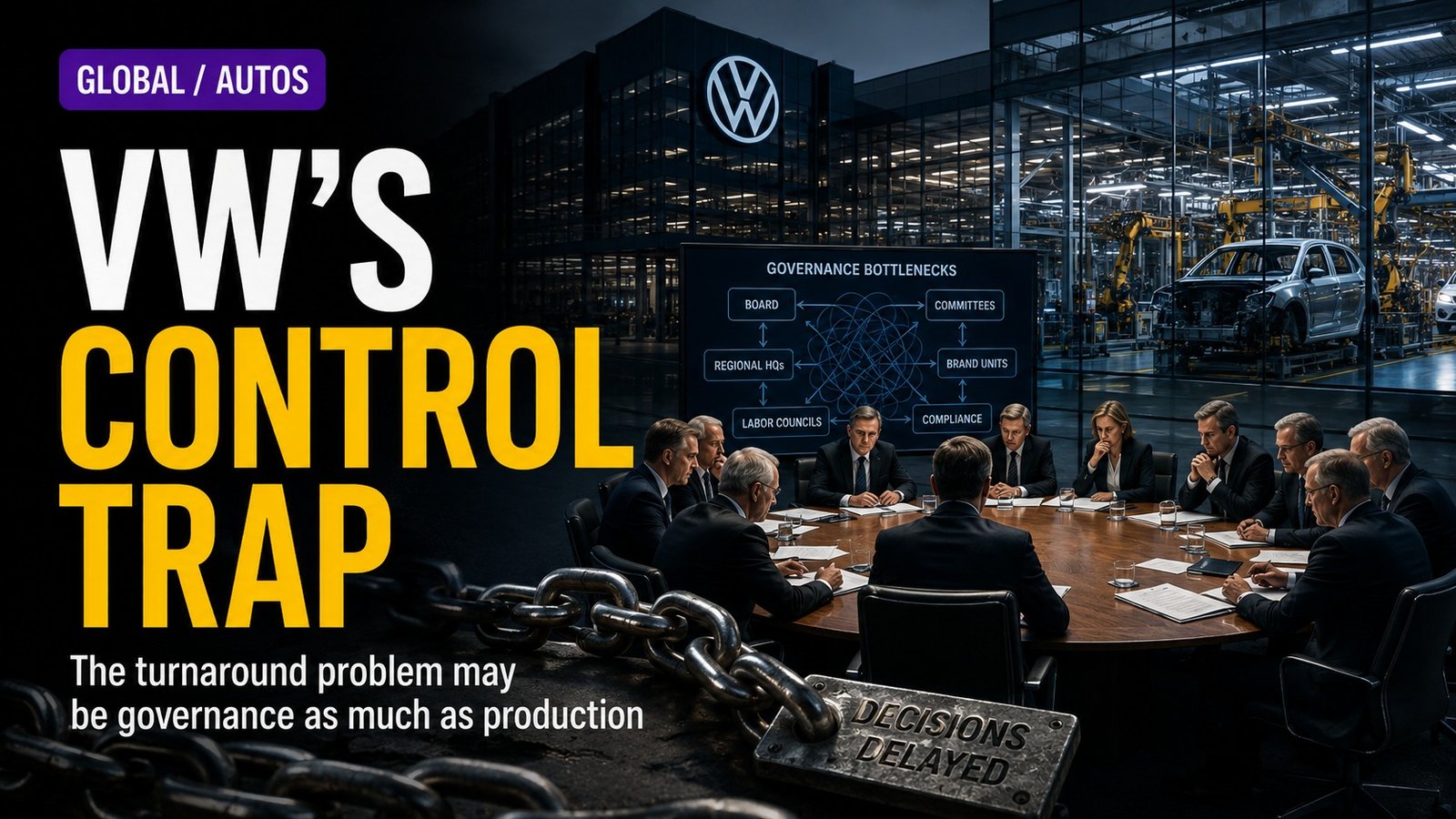
Volkswagen is heading toward a September 4 supervisory-board meeting with management, labour and Lower Saxony still debating how deep the next restructuring phase should go.
Cost pressure is not in dispute. Volkswagen itself says the group needs lower overhead, less complexity and more competitive production economics. The hard part is governance: labour representatives hold half the supervisory-board seats, while Lower Saxony has a blocking influence over major decisions. That makes execution speed a valuation variable.
WHAT HAPPENED
Reuters reported that Lower Saxony’s premier wants an agreement before the September meeting as CEO Oliver Blume pushes for deeper restructuring.
Volkswagen says it has already agreed to reduce around 50,000 positions at Volkswagen, Audi, Porsche and CARIAD in Germany by 2030, with roughly 37,000 signed departure agreements. The company also says overhead costs remain well above comparable-company levels and further measures are being assessed.
Its half-year results showed an operating margin of 3.8%, which management said remained too low.
WHAT EVERYONE IS WATCHING
Markets will focus on the ultimate number of job reductions and whether factories are closed or repurposed.
The overlooked issue is approval friction. A restructuring only creates value if management can convert a benchmarked cost gap into actual decisions. Volkswagen’s stakeholder model can protect employment and industrial capacity, but it can also slow radical action.
WHAT THE MARKET MAY BE MISSING
Governance can become a competitive cost.
Chinese automakers can often change product, capacity and staffing decisions faster. Volkswagen operates across a much more negotiated structure of labour agreements, regional politics and brand interests. The economic value of the next plan therefore depends not only on its ambition, but on how much of it can be approved and executed.
A compromise may ultimately be better than the most aggressive plan — but investors need evidence that the compromise closes the margin gap.
THE NUMBERS
• Existing agreed German position reductions across VW, Audi, Porsche and CARIAD by 2030: about 50,000 • Signed departure agreements cited by VW: around 37,000 • H1 2026 operating margin: 3.8% • Next major supervisory-board meeting: September 4 • Key governance actors: management, labour and Lower Saxony
POSITIVE CASE
The board reaches a credible compromise that reduces overhead and excess capacity while preserving key technology investment. Execution certainty could matter more than the maximum job-cut number.
DOWNSIDE CASE
Governance conflict delays decisions, cost gaps persist and Chinese or tariff pressure worsens. Volkswagen could then spend more time negotiating its cost base than competitors spend changing theirs.
WHAT WOULD CHANGE THE STORY
The September 4 outcome, confirmed cost targets, plant decisions, headcount actions and margin guidance will determine whether the restructuring moves from debate to measurable execution.
RELATED THEMES
Volkswagen, European autos, Germany, labour governance, Lower Saxony, China competition, tariffs and industrial restructuring.
PRICEVIA VIEW
VW does not need another headline about possible cuts. It needs a plan that can pass its own governance system. That is the bottleneck investors should price.
SOURCES & TIMESTAMP
Reuters August 29 restructuring report; Volkswagen official August 21 transformation interview and H1 2026 results, accessed August 30 IST.
MARKET-RISK DISCLAIMER
For information and education only; not investment advice. Markets, regulatory outcomes, transaction terms and company guidance can change. Time-sensitive facts should be rechecked before acting.
Related PriceVia analysis

BRICS Wants to Rewrite Global Finance — Payments Are the First Real Test
Finance ministers demanded a bigger emerging-market voice and faster, cheaper cross-border payments; turning a joint statement into interoperable infrastructure is the harder step.

ByteDance Borrowed $29.6 Billion Without Collateral — Nearly 30 Banks Wanted In
The three-year facility grew from a $20 billion target after overwhelming lender demand, with Chinese banks providing more than 60% and overseas AI infrastructure absorbing much of the capital.

One Refinery, a $47 Billion Valuation: Africa’s Biggest IPO Faces Its Hardest Question
Nigeria approved a 4.1-billion-share offer that could raise $1.63 billion, but the implied valuation towers over listed refining peers while detailed financial statements remain limited.
GoPro Lost 96% — Now a $285 Million Deal Is Sending It From Cameras to Defense and AI
Starman Optical will own about 90% of the combined listed company, repay GoPro’s $92 million debt and try to monetise more than 2,500 US patents beyond consumer action cameras.