Warsh Didn’t Promise a Hike — But One Sentence Put September Back in Play
The new Fed chair avoided forward guidance, yet his standard for inflation was clear enough to push short-term yields higher and keep another rate increase live.
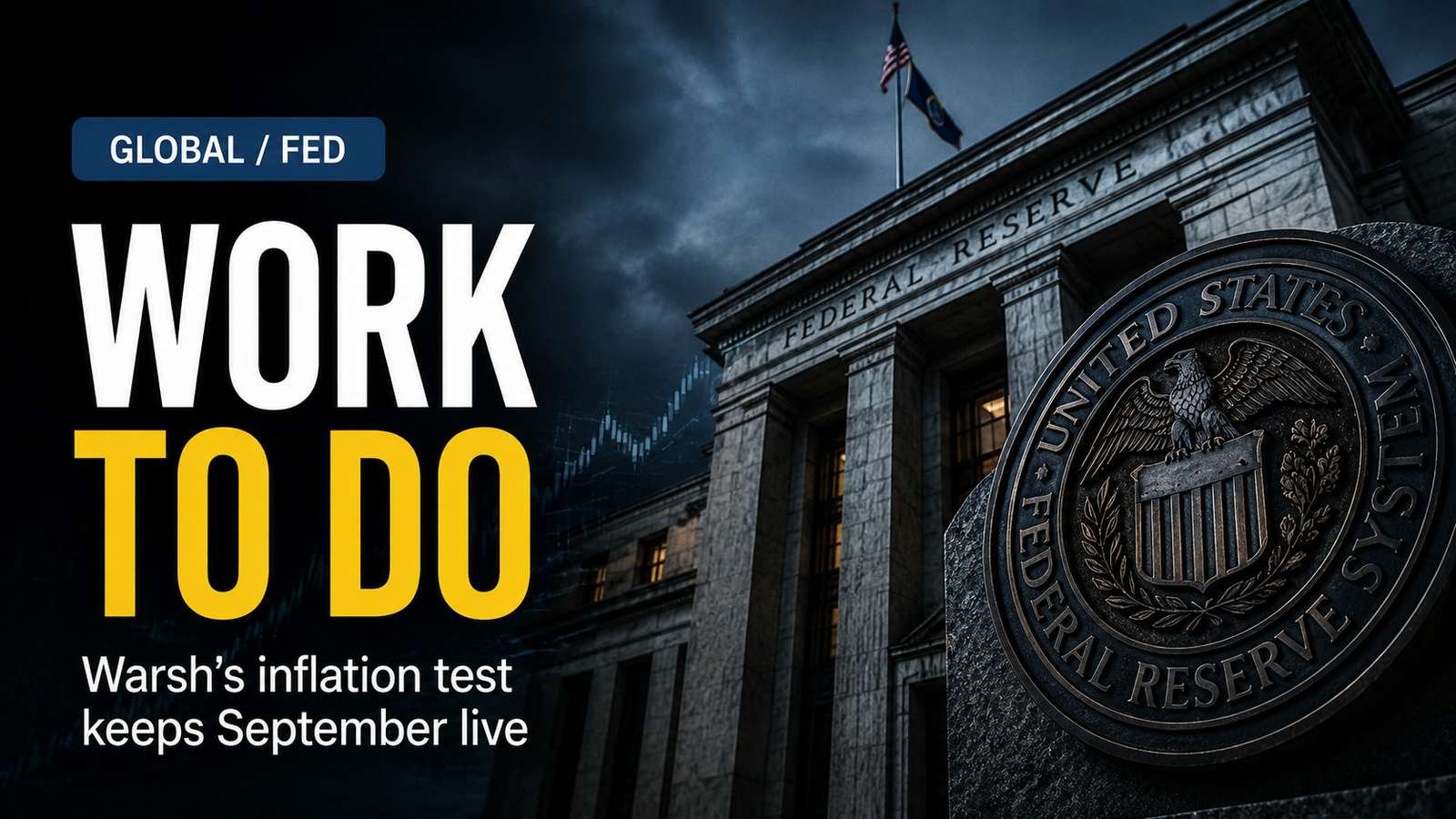
Kevin Warsh used his first Jackson Hole address as Federal Reserve chair to reject the idea that markets should expect a simple policy roadmap. Yet he still gave investors a test that matters: the Fed must be confident underlying inflation is moving to 2% clearly and at sufficient speed — otherwise, in his words, it has “work to do.”
That is not a promise to raise rates in September. It is a higher bar for declaring victory, and bond markets treated it that way.
WHAT HAPPENED
Warsh’s speech focused on AI, the limits of economic forecasting, the drawbacks of excessive forward guidance and principles for monetary policy.
On inflation, he argued that yesterday’s news can be mistaken for current conditions and said the Fed must see convincing progress toward its objective. Market reports after the speech showed short-dated Treasury yields rising and expectations for a September hike increasing.
WHAT EVERYONE IS WATCHING
Most investors are watching the probability of the next 25-basis-point move.
The deeper question is how Warsh wants the Fed to communicate. He is deliberately reducing dependence on forward guidance, which means markets may need to infer more from incoming data and fewer explicit policy promises. That can raise volatility around every inflation and labour release.
WHAT THE MARKET MAY BE MISSING
A less communicative Fed does not necessarily mean a less predictable Fed. If Warsh replaces verbal guidance with a more consistent reaction function, markets could eventually gain clarity.
The transition is the risky period. Investors accustomed to detailed projections and calibrated language may overreact to individual speeches or data points while learning the new framework.
THE NUMBERS
• Fed’s inflation objective: 2% • Warsh’s test: underlying inflation must move clearly and sufficiently toward target • Policy message: no decision pre-committed • Market reaction: short-term Treasury yields rose after the speech • September policy expectations moved toward a higher probability of a hike
POSITIVE CASE
If inflation data improve before the meeting, Warsh can maintain credibility without tightening again. A clearer rules-based framework could reduce long-run policy uncertainty.
DOWNSIDE CASE
If inflation remains sticky while energy prices stay elevated, the Fed may need to tighten into a slower-growth environment. That would pressure duration-sensitive equities, housing and leveraged balance sheets.
WHAT WOULD CHANGE THE STORY
The August jobs report, next inflation readings, inflation expectations and any follow-up Fed communication will decide whether “work to do” becomes an actual rate move.
RELATED THEMES
Federal Reserve, Treasury yields, dollar, S&P 500, Nasdaq, banks, housing and gold.
PRICEVIA VIEW
The speech’s importance is not that Warsh promised action. He did the opposite. The signal is that he set a strict inflation test while removing some of the guidance markets normally use to front-run the Fed.
SOURCES & TIMESTAMP
Federal Reserve official Jackson Hole speech dated August 28, cross-checked with FT and WSJ market reaction, accessed August 29, 2026 IST.
MARKET-RISK DISCLAIMER
For information and education only; not investment advice. Markets, regulatory decisions and transaction terms can change, and investors should verify time-sensitive information before acting.
Related PriceVia analysis

India and China Are Talking Again — The $100 Billion Trade Gap Is Still in the Room
Xi Jinping’s first India visit in seven years signals a diplomatic reset, but record bilateral commerce remains shaped by Indian dependence on Chinese machinery, electronics and industrial inputs.

The India–EU Trade Deal Cleared Another Gate — Ratification Is the Real Finish Line
The European Commission has advanced the agreement toward Council approval and signature, but tariff savings and 2027 implementation still depend on legal completion and ratification.
US Inflation Put a Rate Hike Back on the Table — Bonds Are Already There
August CPI accelerated, real wages fell again and markets priced an 87% chance of a quarter-point hike; the near-5% Treasury yield is tightening conditions before the Fed votes.

India Helped Kill Europe’s 15% Scrap Duty — But the Supply Win May Expire
Brussels abandoned a three-year export levy as an India trade deal nears, yet tougher waste rules could still block direct shipments from May 2027.