France’s Wine Harvest Is Heading for a 30-Year Low — Champagne Could Fall 49%
Heat and drought cut the national forecast to 33.9 million hectolitres, but shrinking vineyards, tariffs and six-decade-low consumption make this more than a weather story.
France’s Wine Harvest Is Heading for a 30-Year Low — Champagne Could Fall 49%
**Heat and drought cut the national forecast to 33.9 million hectolitres, but shrinking vineyards, tariffs and six-decade-low consumption make this more than a weather story.**
*By PriceVia Global Desk | September 7, 2026*
Why now
Heat and drought cut the national forecast to 33.9 million hectolitres, but shrinking vineyards, tariffs and six-decade-low consumption make this more than a weather story.
Key points
- France forecasts 33.9 million hectolitres of wine, 6% below 2025 and 17% below its five-year average. - Champagne output is projected to fall 49% year on year and 47% versus the five-year average. - The vineyard area shrank 2.5% as weak consumption and oversupply prompted vine removals.
The numbers
| Metric | Value | Context | |---|---:|---| | National output | 33.9m hl | 2026 forecast | | Year-on-year change | -6% | Versus 2025 | | Five-year gap | -17% | Versus 2021–2025 average | | Champagne | -49% | Year on year | | Bottles equivalent | ~4.5bn | National forecast | | Vineyard area | -2.5% | Year on year |
What happened
France is heading toward one of its smallest wine harvests in three decades after record summer heat and drought damaged vines and reduced grape yields. The agriculture ministry projected 33.9 million hectolitres for 2026—about 4.5 billion standard bottles—down 6% from 2025 and 17% below the 2021–2025 average. [S1, S2] Champagne faces the sharpest headline fall: output is forecast 49% below last year and 47% below the five-year average. Bourgogne-Beaujolais is expected to fall by about one-third. Bordeaux may rise 10% from a weak 2025 after late-August rain, while remaining below its recent average. [S1]
What everyone is watching
Quality and price do not move mechanically with volume. Heat can concentrate fruit but can also reduce acidity and damage berries. Producers must decide which grapes meet appellation standards, while merchants balance scarce new wine against inventories from earlier vintages. A smaller harvest does not automatically create an equal retail-price increase. Demand is weak at the same time. French wine consumption is at its lowest in more than 60 years, and the industry has faced US tariffs and changing health preferences. Vineyard area fell 2.5% as growers removed vines to address oversupply, meaning part of the output decline is structural rather than purely climatic. [S1, S3]
The overlooked PriceVia angle
PriceVia analysis: France is experiencing scarcity and oversupply simultaneously. Premium appellations can face limited high-quality grapes while mass-market regions still struggle with declining consumption. National volume therefore hides very different pricing power across Champagne, Bordeaux, Burgundy and southern bulk-wine producers. The 2026 shock also changes future capacity. A bad weather year can recover next season, but uprooted vineyards do not return quickly. If demand later stabilises, the smaller planted base could tighten supply more persistently than this harvest forecast suggests.
Positive scenario
Remaining grapes deliver strong quality, premium brands protect pricing and lower output clears excess inventory. Government support helps viable growers adapt irrigation and vineyard practices without destroying long-term capacity.
Risk scenario
Heat damages quality as well as quantity, tariffs and weak consumption limit price increases, and small growers absorb another low-income year. More vineyards are removed, permanently shrinking regional ecosystems and supplier networks.
What would change the story
Watch final harvest volumes, grape quality, producer prices, Champagne allocations, export orders, US tariff policy, inventory, insolvencies and vineyard removals. Strong premium export pricing despite lower volume would separate scarcity winners from demand-challenged regions.
Related stocks and themes
LVMH, Rémy Cointreau, Pernod Ricard, luxury beverages, French agriculture, climate risk, glass bottles, vineyard land, US tariffs and premium consumption.
Sources and timestamps
- [S1 — Reuters: ministry forecast and regional breakdown](https://www.reuters.com/business/french-wine-output-be-among-lowest-30-years-after-heatwaves-2026-09-07/) — published 2026-09-07; accessed 2026-09-08T00:40:00+05:30 - [S2 — France Agreste: official agricultural statistics portal](https://agreste.agriculture.gouv.fr/agreste-web/) — published 2026-09-07; accessed 2026-09-08T00:40:00+05:30 - [S3 — OIV: global wine production and consumption data](https://www.oiv.int/what-we-do/statistics) — published accessed 2026-09-07; accessed 2026-09-08T00:40:00+05:30 - [S4 — Le Monde: pre-harvest drought and quality risks](https://www.lemonde.fr/en/economy/article/2026/07/30/france-s-grape-harvest-threatened-by-drought-despite-promising-2026-vintage_6756010_19.html) — published 2026-07-30; accessed 2026-09-08T00:40:00+05:30
Visual disclosure
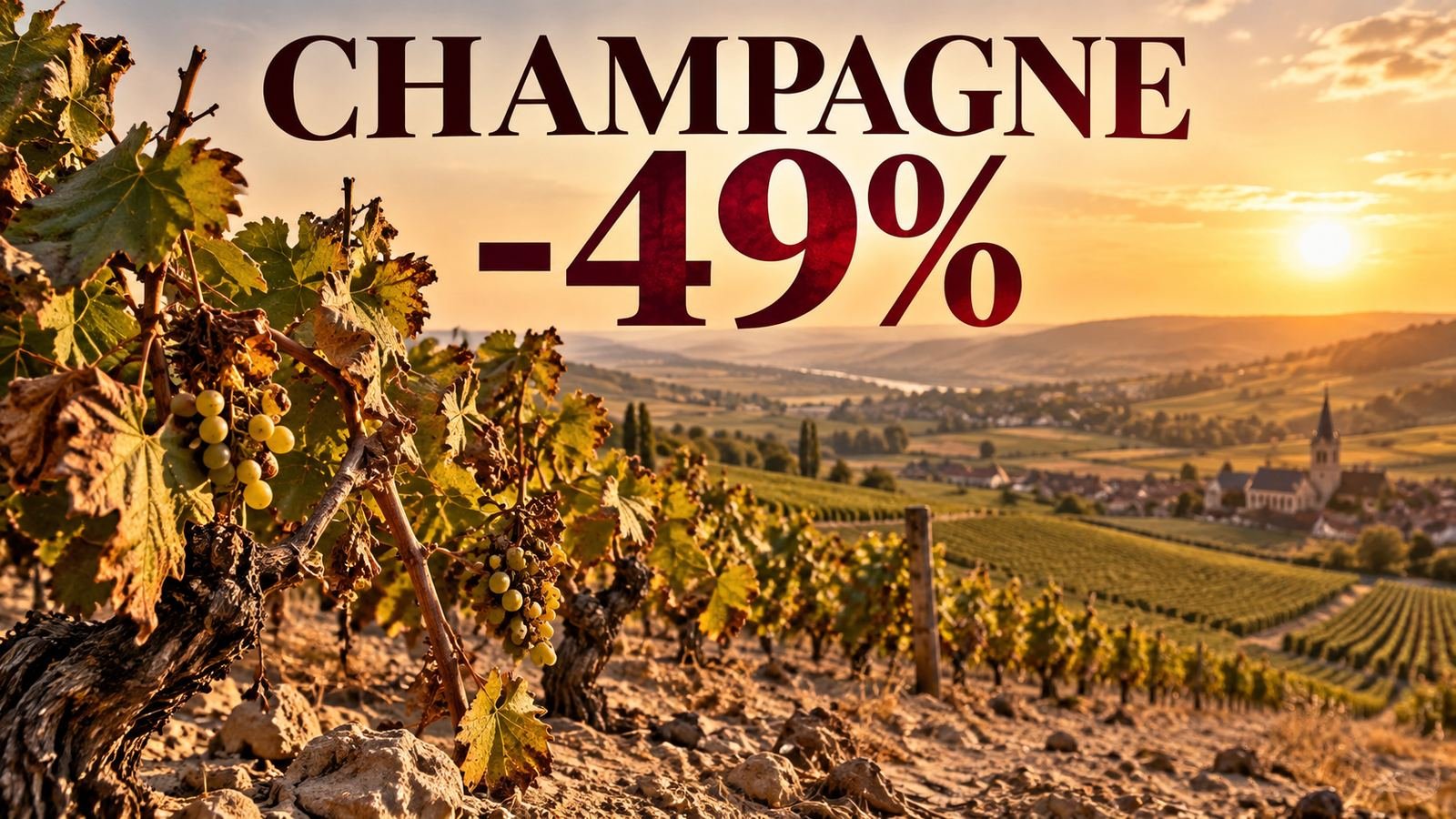
Hero visual created specifically for this article. Thumbnail text: “CHAMPAGNE -49%”. It is an editorial illustration, not a market-data screenshot.
Market-risk disclaimer
This article is for market education and information only. It is not investment advice, a recommendation, or a promise of returns. Prices, transaction terms, approvals, company plans and regulations can change; verify the latest primary disclosures and assess risk independently.
- Final harvest
- Quality and pricing
- Vineyard removals
Risk context: This article is for market education and information only. It is not investment advice, a recommendation, or a promise of returns. Prices, transaction terms, approvals, company plans and regulations can change; verify the latest primary disclosures and assess risk independently.
- reuters.com2026-09-07
- agreste.agriculture.gouv.fr2026-09-07
- oiv.intaccessed 2026-09-07
- lemonde.fr2026-07-30
Related PriceVia analysis

Trump Removed Irish Whiskey’s 10% Tariff — Now the Paperwork Must Catch Up
The announcement offers relief to distillers after duties on EU wine and spirits, but exporters still need a formal implementation path and want zero-for-zero treatment across the drinks trade.

India Is Importing Sugar Again — Festival Prices Forced the Door Open
New Delhi allowed one million tonnes of duty-free imports and warned mills to keep supplies adequate after hoarding pushed prices to a record and 20% above levels two months earlier.

India and China Are Talking Again — The $100 Billion Trade Gap Is Still in the Room
Xi Jinping’s first India visit in seven years signals a diplomatic reset, but record bilateral commerce remains shaped by Indian dependence on Chinese machinery, electronics and industrial inputs.

The India–EU Trade Deal Cleared Another Gate — Ratification Is the Real Finish Line
The European Commission has advanced the agreement toward Council approval and signature, but tariff savings and 2027 implementation still depend on legal completion and ratification.