India’s Rice Crop Could Shrink by 10 Million Tonnes — Record Stocks Are the Only Cushion
Rainfall deficits of as much as 42% in key regions threaten the sharpest production decline in nearly two decades, but unusually large inventories could keep exports open.
India’s Rice Crop Could Shrink by 10 Million Tonnes — Record Stocks Are the Only Cushion
*By PriceVia Macro Desk | Published September 19, 2026 | Updated September 19, 2026*
Why this matters now
Rainfall deficits of as much as 42% in key regions threaten the sharpest production decline in nearly two decades, but unusually large inventories could keep exports open.
Key points
- Industry estimates point to a 10-million-tonne year-on-year production drop. - Some rice-producing states received up to 42% less rainfall during a critical crop stage. - Record government inventories may prevent export restrictions despite tighter new supply.
The numbers
| Metric | Value | Context | |---|---:|---| | Possible output drop | 10m tonnes | 2026/27 versus prior year | | Rainfall deficit | Up to 42% | Some producing states | | Frequency | First fall in a decade | Production direction | | Severity | Largest in ~20 years | Expected decline | | India rank | No. 1 | Producer and exporter | | Cushion | Record stocks | Export buffer |
What happened — confirmed facts
Industry officials told Reuters that weak rainfall during crop maturation may cut Indian rice production for the first time in ten years and by the most in almost two decades. Estimates remain forecasts until government crop data confirms them. [S1, S2] Lower output can raise domestic and export prices, especially while Thailand and Vietnam also face firmer markets. India’s record inventories, however, give policymakers more flexibility than a harvest figure alone suggests. [S1, S3]
What everyone is watching
The most important confirmation will be state-level yield data, procurement arrivals and the mix between common and premium varieties. A national total can hide sharper shortages in tradable grades. Policy risk depends on retail inflation and stock releases. Large inventories can support exports, but authorities may still adjust sales, duties or minimum prices if household food costs accelerate.
What the market may be missing — PriceVia analysis
PriceVia analysis: stocks convert a production shock into a timing problem. They can smooth one weak season, but sustained drawdowns would reduce the safety margin for the following crop. Exporters may keep volume while losing price competitiveness. Buyers can diversify toward Thailand, Vietnam or Pakistan if Indian quotations rise, changing market share even without a formal restriction.
Positive case
Late weather improves yields, inventories bridge the shortfall and exports continue without destabilising domestic prices. Farmers receive firmer prices while food inflation remains manageable.
Downside case
The crop undershoots estimates, procurement weakens and retail prices jump. Policy intervention then disrupts exporters and downstream food businesses despite record stocks.
What would change the story
Official production estimates, procurement data, state rainfall, stock releases and export quotations will show whether the cushion is genuinely sufficient.
Related stocks and themes
Rice exporters, food processors, fertiliser, rural consumption, agricultural logistics, government procurement and Asian grain markets.
How to read it
Monitor grades, procurement and stocks together, and avoid translating a forecast national shortfall directly into an identical earnings effect for every exporter.
Reader checklist
- Confirm official crop estimate in a primary disclosure before changing the thesis. - Compare government stock releases with the headline narrative; they may move in different directions. - Reassess after new information on export price spreads rather than treating the first report as a completed outcome.
PriceVia View
The headline is a smaller harvest; the investable variable is how quickly India spends its inventory cushion to protect consumers and export credibility.
Sources and timestamps
- [S1 — Reuters: India rice output risk](https://www.reuters.com/world/india/india-rice-output-faces-biggest-drop-two-decades-stocks-cushion-exports-2026-09-17/) — published 2026-09-17 08:01 UTC; accessed 2026-09-19T13:15:00+05:30 - [S2 — Agriculture Ministry crop estimates](https://agriwelfare.gov.in/en/Agricultural_Statistics) — published 2026-09-19; accessed 2026-09-19T13:15:00+05:30 - [S3 — Food Corporation of India stocks](https://fci.gov.in/) — published 2026-09-19; accessed 2026-09-19T13:15:00+05:30 - [S4 — India Meteorological Department rainfall](https://mausam.imd.gov.in/) — published 2026-09-19; accessed 2026-09-19T13:15:00+05:30
Visual disclosure
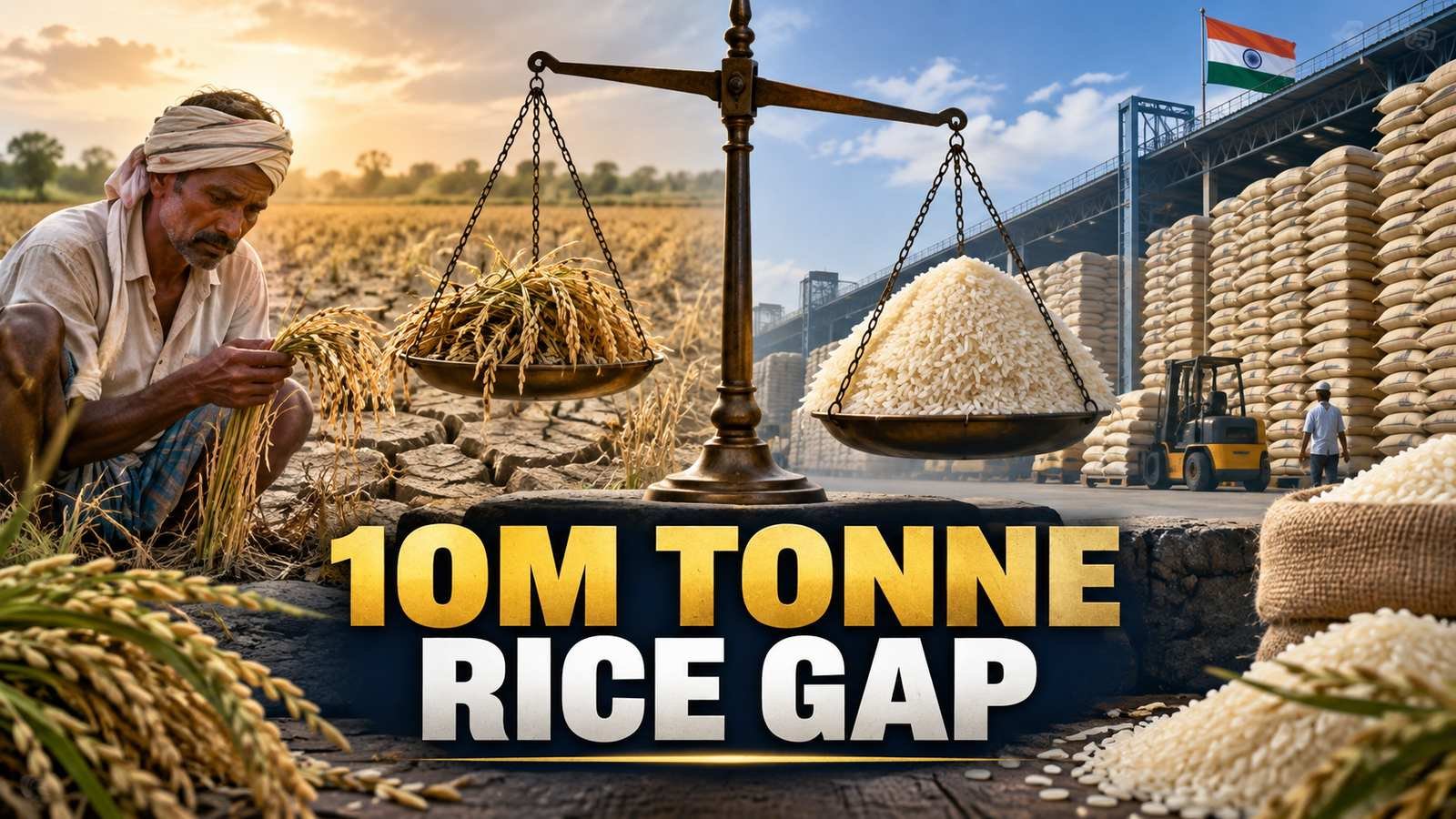
Hero visual created specifically for this article. Thumbnail text: “10M TONNE RICE GAP”. It is an editorial illustration, not a market-data, legal or regulatory screenshot.
Market-risk disclaimer
This article is for market education and information only. It is not investment advice, a recommendation or a promise of returns. Market prices, policy decisions, deal terms and forecasts can change. Verify the latest primary disclosures and assess suitability and risk independently.
- official crop estimate
- government stock releases
- export price spreads
Risk context: This article is for market education and information only. It is not investment advice, a recommendation or a promise of returns. Market prices, policy decisions, deal terms and forecasts can change. Verify the latest primary disclosures and assess suitability and risk independently.
- reuters.com2026-09-17 08:01 UTC
- agriwelfare.gov.in2026-09-19
- fci.gov.in2026-09-19
- mausam.imd.gov.in2026-09-19
Related PriceVia analysis
Delhi Metro Carried a Record 82.45 Lakh Riders in One Day — A Bus Strike Revealed Its Spare Capacity
A sudden DTC bus disruption pushed Delhi Metro to a new daily record, testing whether the network can absorb shocks without letting reliability deteriorate.
India Gave Compressed Biogas an Assured Buyer — Price Support Could Finally Turn Waste Into Bankable Fuel
New GOBARdhan rules address the two questions that have stalled many waste-to-gas projects: who will buy the output and how predictable will the price be.

India's New ESG Assurance Standard Starts in April 2027 — Two Big Carve-Outs Will Shape What Investors Can Trust
SSA 5000 broadens assurance across climate, labour and biodiversity disclosures, but excludes joint audits and forward-looking statements from the international framework.
India's Forex Reserves Fell $4.92 Billion — The $780.78 Billion Buffer Is Being Put to Work
The weekly decline arrived as traders reported central-bank dollar selling near a rupee record low, illustrating that reserves are insurance to be deployed—not a score that must rise every week.