Latvia Plans a 300% Grain Tariff — The Real Target Is Russia’s New Baltic Escape Route
The proposal would target grain arriving from Russia and Belarus as disrupted Black Sea and Baltic routes push exporters toward Latvian railways and ports.
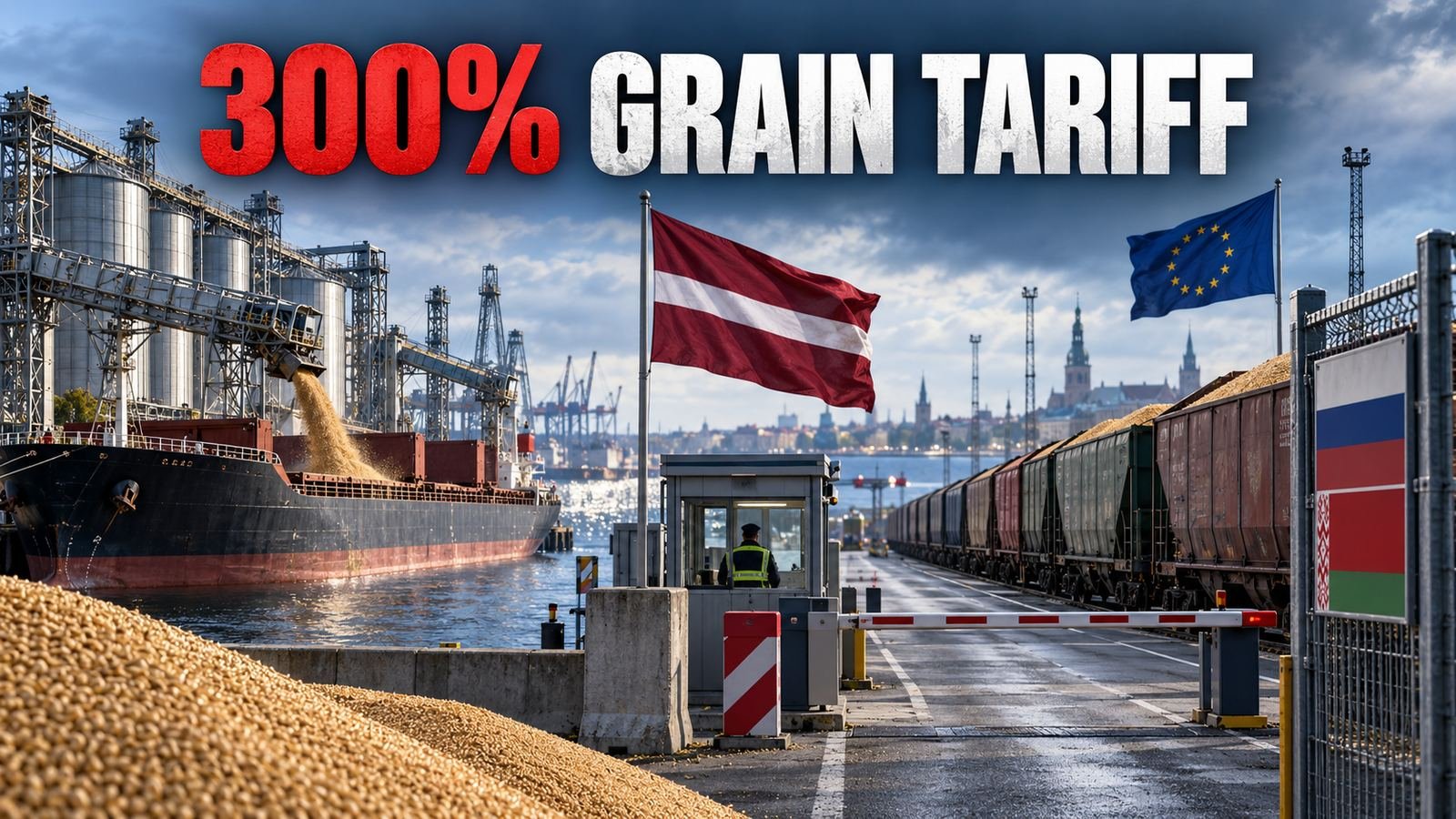
Latvia Plans a 300% Grain Tariff — The Real Target Is Russia’s New Baltic Escape Route
**The proposal would target grain arriving from Russia and Belarus as disrupted Black Sea and Baltic routes push exporters toward Latvian railways and ports.**
*By PriceVia Global Desk | September 7, 2026*
Why now
The proposal would target grain arriving from Russia and Belarus as disrupted Black Sea and Baltic routes push exporters toward Latvian railways and ports.
Key points
- Prime Minister Andris Kulbergs said Latvia plans a 300% tariff on grain arriving from Russia and Belarus. - The proposal follows discussion with Lithuania and Estonia about restricting Russian grain transit through Baltic infrastructure. - Russia shipped 46.3 million tonnes through Black Sea and Azov ports last season, about 90% of its seaborne grain exports.
The numbers
| Metric | Value | Context | |---|---:|---| | Planned tariff | 300% | Russia and Belarus grain | | Russian grain | 46.3mt | Black Sea/Azov last season | | Seaborne share | 90% | Via those southern ports | | Latvian import ban | To Jul 2027 | Existing farm-goods rule | | Baltic coordination | 3 countries | Latvia, Lithuania, Estonia | | Formal implementation | Pending | Plan, not final tariff schedule |
What happened
Latvia’s government plans to impose a 300% tariff on grain arriving from Russia and Belarus, Prime Minister Andris Kulbergs said on September 7. The announcement follows Baltic discussions about stopping Russian grain from using regional ports and railways after exporters increased transit through Latvia. [S1, S2] The route matters because attacks have disrupted traditional Russian export infrastructure. Industry data cited by Reuters showed 46.3 million tonnes of grain moved through Black Sea and Sea of Azov ports in the July 2025–June 2026 season, about 90% of Russian seaborne grain exports. Baltic access can serve as an alternative when southern or Russian Baltic terminals are constrained. [S1]
What everyone is watching
The legal design is not yet public. Latvia already bans certain Russian and Belarusian agricultural imports into its domestic market, while transit and deliveries to other EU members have been treated differently. A tariff aimed at transit may need careful alignment with European Union customs, trade and port rules. [S3, S4] Enforcement is the second challenge. Grain can be blended, relabelled or routed through intermediaries. Latvia has discussed stronger origin inspections and cooperation with Ukrainian laboratories. Without reliable traceability, a high headline tariff could shift paperwork more than physical flows.
The overlooked PriceVia angle
PriceVia analysis: the proposal targets logistics optionality, not only food imports. Ports, rail terminals, storage operators and traders earn from transit even when grain never enters Latvia’s consumer market. A prohibitive tariff can therefore remove a valuable detour from Russia’s export map during infrastructure disruption. Global grain supply may not disappear; it may travel farther or through more expensive terminals. That can widen regional basis prices, elevate freight and insurance costs, and create opportunities for competing origins. The market impact depends on rerouting capacity rather than the tariff percentage alone.
Positive scenario
Baltic countries coordinate a clear, enforceable rule that reduces sanctions circumvention without disrupting lawful grain flows. Alternative suppliers fill local needs and infrastructure adapts with limited consumer-price impact.
Risk scenario
The measure conflicts with EU rules, fragments Baltic policy or is bypassed through origin laundering. Rerouting raises global freight costs, pressures Latvian port activity and produces limited strategic effect.
What would change the story
Watch the draft law, effective date, customs code, transit treatment, EU response, Baltic coordination, port volumes, origin-testing rules and Russian export routes. A published schedule with enforceable transit provisions would move the plan into market reality.
Related stocks and themes
European grain, Baltic ports, rail freight, agricultural traders, Black Sea shipping, sanctions, food security, customs enforcement and freight insurance.
Sources and timestamps
- [S1 — Reuters: 300% plan and Russian export-route data](https://www.reuters.com/business/latvia-plans-300-tariff-grain-russia-belarus-2026-09-07/) — published 2026-09-07; accessed 2026-09-08T00:40:00+05:30 - [S2 — Latvian report: coalition measures and Baltic coordination](https://news.inbox.lv/150ptpc-latvia-plans-to-introduce-a-300-tariff-on-russian-and-belarusian-grain-cargoes-and-their-processing?language=en) — published 2026-09-07; accessed 2026-09-08T00:40:00+05:30 - [S3 — Latvian public broadcaster: existing import ban extension](https://eng.lsm.lv/article/economy/economy/02.04.2026-grain-imports-ban-from-russia-belarus-to-latvia-extended.a641487/) — published 2026-04-02; accessed 2026-09-08T00:40:00+05:30 - [S4 — EU Council: tariffs on Russian and Belarusian grain](https://www.consilium.europa.eu/en/press/press-releases/2024/05/30/council-sets-higher-tariffs-on-russian-and-belarusian-grain-products/) — published 2024-05-30; accessed 2026-09-08T00:40:00+05:30
Visual disclosure
Hero visual created specifically for this article. Thumbnail text: “300% GRAIN TARIFF”. It is an editorial illustration, not a market-data screenshot.
Market-risk disclaimer
This article is for market education and information only. It is not investment advice, a recommendation, or a promise of returns. Prices, transaction terms, approvals, company plans and regulations can change; verify the latest primary disclosures and assess risk independently.
- Final legal text
- EU compatibility
- Baltic transit volumes
Risk context: This article is for market education and information only. It is not investment advice, a recommendation, or a promise of returns. Prices, transaction terms, approvals, company plans and regulations can change; verify the latest primary disclosures and assess risk independently.
- reuters.com2026-09-07
- news.inbox.lv2026-09-07
- eng.lsm.lv2026-04-02
- consilium.europa.eu2024-05-30
Related PriceVia analysis
India and China Are Talking Again — The $100 Billion Trade Gap Is Still in the Room
Xi Jinping’s first India visit in seven years signals a diplomatic reset, but record bilateral commerce remains shaped by Indian dependence on Chinese machinery, electronics and industrial inputs.

The India–EU Trade Deal Cleared Another Gate — Ratification Is the Real Finish Line
The European Commission has advanced the agreement toward Council approval and signature, but tariff savings and 2027 implementation still depend on legal completion and ratification.

US Inflation Put a Rate Hike Back on the Table — Bonds Are Already There
August CPI accelerated, real wages fell again and markets priced an 87% chance of a quarter-point hike; the near-5% Treasury yield is tightening conditions before the Fed votes.
India Helped Kill Europe’s 15% Scrap Duty — But the Supply Win May Expire
Brussels abandoned a three-year export levy as an India trade deal nears, yet tougher waste rules could still block direct shipments from May 2027.