India’s Earnings Are Improving — So Why Isn’t the Market Acting Like It?
Better earnings should help Indian equities. The problem is that the primary market may be competing for the same capital just as foreign investors remain cautious.

Good earnings are not automatically creating a good market
Indian companies have delivered a better earnings backdrop than many investors expected, yet the headline indices have struggled. That disconnect is important because it suggests profits are only one part of the equation.
Reuters reported the Nifty 50 and Sensex were still down materially for the year as of August 19, even while corporate profitability and domestic demand showed resilience.
The primary market is competing for the same money
One explanation is the size of the IPO and institutional-placement pipeline. New issues do not create free liquidity; they compete with existing listed companies for investor capital.
Abakkus Investment Managers told Reuters that primary-market activity could absorb a very large portion of available investment capital. That means strong earnings can be offset by a simple supply problem: too many securities are asking for money at the same time.
What most people may be missing
Investors often treat IPO activity as proof that market confidence is strong. It can be. But a huge issuance calendar can also drain demand from the secondary market, especially when foreign investors are already cautious.
That creates a strange setup where the economy looks healthier, companies make more money, and individual IPOs perform well — while the broader index struggles to build sustained momentum.
Foreign flows make the liquidity question harder
Reuters cited record foreign outflows of roughly $25 billion in 2026. Domestic institutions have been absorbing much of that pressure, but the combination of foreign selling and heavy primary issuance makes the burden on local liquidity larger.
This does not mean Indian equities lack buyers. It means those buyers have more choices, and every large new issue competes with existing stocks for allocation.
Where the market may become more selective
In that environment, investors may care less about broad index exposure and more about companies with visible earnings growth, reasonable valuations and strong balance sheets. Abakkus highlighted selected NBFCs and mid-sized banks as areas where credit growth and earnings can still create opportunity.
The broader lesson is that a rising profit cycle does not lift every stock equally when the cost of capital and supply of new shares are both high.
What would unlock a stronger revival
A cleaner setup would require some combination of lower oil prices, calmer global yields, slower foreign selling and a primary-market calendar that no longer absorbs such a large share of fresh capital.
If those conditions improve while earnings remain healthy, the index could finally begin reflecting the better corporate backdrop. Until then, stock selection may matter more than the headline earnings story.
- The pace and size of major IPOs and placements.
- Monthly FPI flows.
- Q2 earnings revisions for financials and IT.
- Whether domestic institutional buying continues to absorb supply.
Risk context: The article discusses liquidity and valuation dynamics, not a forecast that Indian equities must rise or fall.
Related PriceVia analysis
 MONEY IS ROTATING
Indian Banks Are Quietly Winning While the Nifty Goes Nowhere
The headline index is barely moving, but the market underneath it is not calm. Money is rotating toward private banks while technology and other rate-sensitive pockets absorb the pressure.
 RISK IS BUILDING
Indian Markets Look Calm. Oil and Global Bond Yields Are Quietly Raising the Risk
The index barely moved on Friday. That calm surface may be hiding a more important combination: expensive oil, volatile global yields and pressure on India’s currency and foreign flows.

Nifty Faces an Expiry Test as Oil and Iran Risk Return — The Bigger Threat May Be Food Inflation
Indian equities enter monthly expiry with Brent near $92 and geopolitical risk elevated, but a weak monsoon could become the more persistent domestic problem.
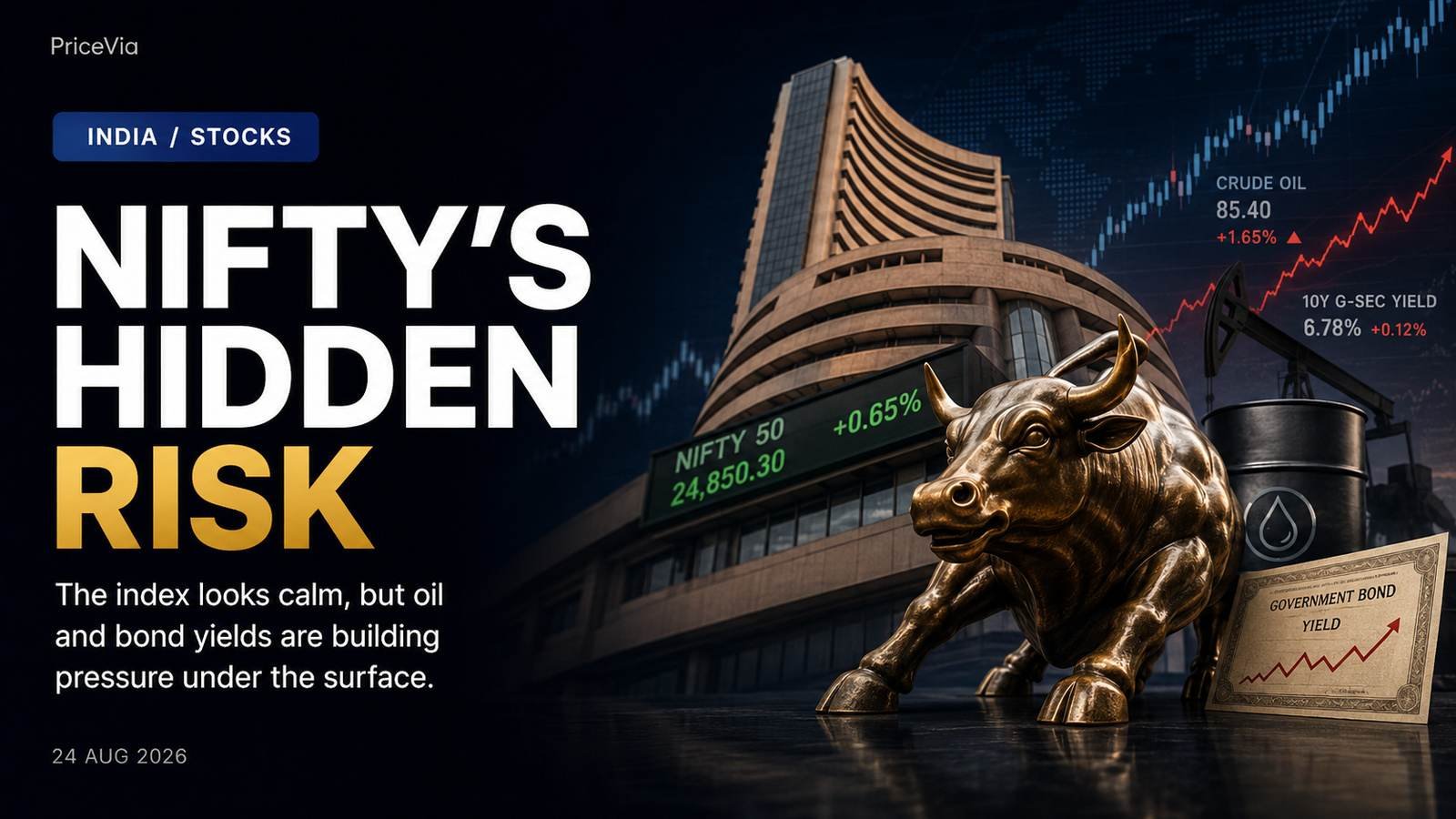
Nifty Is Trying to Bounce — But $93 Oil Is Still the Number That Matters
Indian equities are trying to start the week on a better footing, but the market’s most important number may still be sitting outside the stock screen: Brent crude near $93 a barrel.