Nifty 50 Profits Grow 18% as Corporate India Delivers Its Best Quarter in 10 Quarters
Corporate India's June-quarter earnings season has delivered a significant positive surprise. Nifty 50 companies posted average profit growth of 18%, the strongest pace in 10 quarters, according to Reuters' review of brokerage estimates.

Corporate India's June-quarter earnings season has delivered a significant positive surprise. Nifty 50 companies posted average profit growth of 18%, the strongest pace in 10 quarters, according to Reuters' review of brokerage estimates.
The breadth of the beat is as important as the headline number. Nineteen sectors outperformed expectations and Motilal Oswal's upgrade-to-downgrade ratio improved to 1.5, meaning upgrades materially outnumbered downgrades. That suggests analysts are not only acknowledging a strong reported quarter but also becoming more constructive about the remainder of the fiscal year.
Large-cap contributors included Hindalco, Reliance Industries, JSW Steel, ONGC and Bharti Airtel. Lenders also benefited from faster credit growth, low credit costs and operating leverage, while non-bank financial companies reported healthy asset growth and broadly stable asset quality.
This matters because Indian equities have spent much of 2026 facing a difficult external backdrop. Elevated crude prices, foreign portfolio outflows and rising global yields have pressured valuations. Stronger earnings offer a domestic counterweight: if profits rise fast enough, valuation multiples can compress even without a major fall in share prices.
The quality of growth remains uneven. Oil marketing companies were a clear weak spot because crude volatility created losses and inventory-related pressure. Several consumer and industrial sectors also reported margin stress from higher metals, crude derivatives, palm oil, freight and wages. IT services faced a separate challenge from AI-linked pricing pressure.
That means investors should avoid treating the 18% figure as proof that every sector is entering the same earnings cycle. The more useful conclusion is that the aggregate profit pool has broadened enough to improve the market's fundamental support.
Brokerages are looking to festive demand, consumption support, credit expansion and investment activity as potential drivers of fiscal 2027 earnings. If those factors remain intact, India may be able to sustain profit growth even while global markets remain volatile.
The key risk is that external shocks overwhelm domestic momentum. A prolonged oil spike would hit inflation, the rupee and corporate margins. High U.S. yields could also keep foreign capital cautious. In addition, heavy IPO and institutional issuance can absorb liquidity that might otherwise support the secondary market.
For long-term investors, the earnings season improves the case for focusing on companies with pricing power, balance-sheet strength and visible volume growth rather than relying on a broad index rerating. An 18% profit-growth quarter creates a stronger base, but future returns will still depend on what investors pay for those earnings.
The June quarter has therefore changed the tone of the Indian market debate. The question is no longer only whether global risks can hurt India. It is whether domestic earnings can remain strong enough to offset them. For now, the data give bulls more fundamental evidence than they had a few months ago.
Risk context: Prepared as an original PriceVia explainer using the linked source reporting. Market levels and event details are timestamp-sensitive and should be rechecked before later republication.
Related PriceVia analysis

Nifty Faces an Expiry Test as Oil and Iran Risk Return — The Bigger Threat May Be Food Inflation
Indian equities enter monthly expiry with Brent near $92 and geopolitical risk elevated, but a weak monsoon could become the more persistent domestic problem.

Nifty Is Trying to Bounce — But $93 Oil Is Still the Number That Matters
Indian equities are trying to start the week on a better footing, but the market’s most important number may still be sitting outside the stock screen: Brent crude near $93 a barrel.
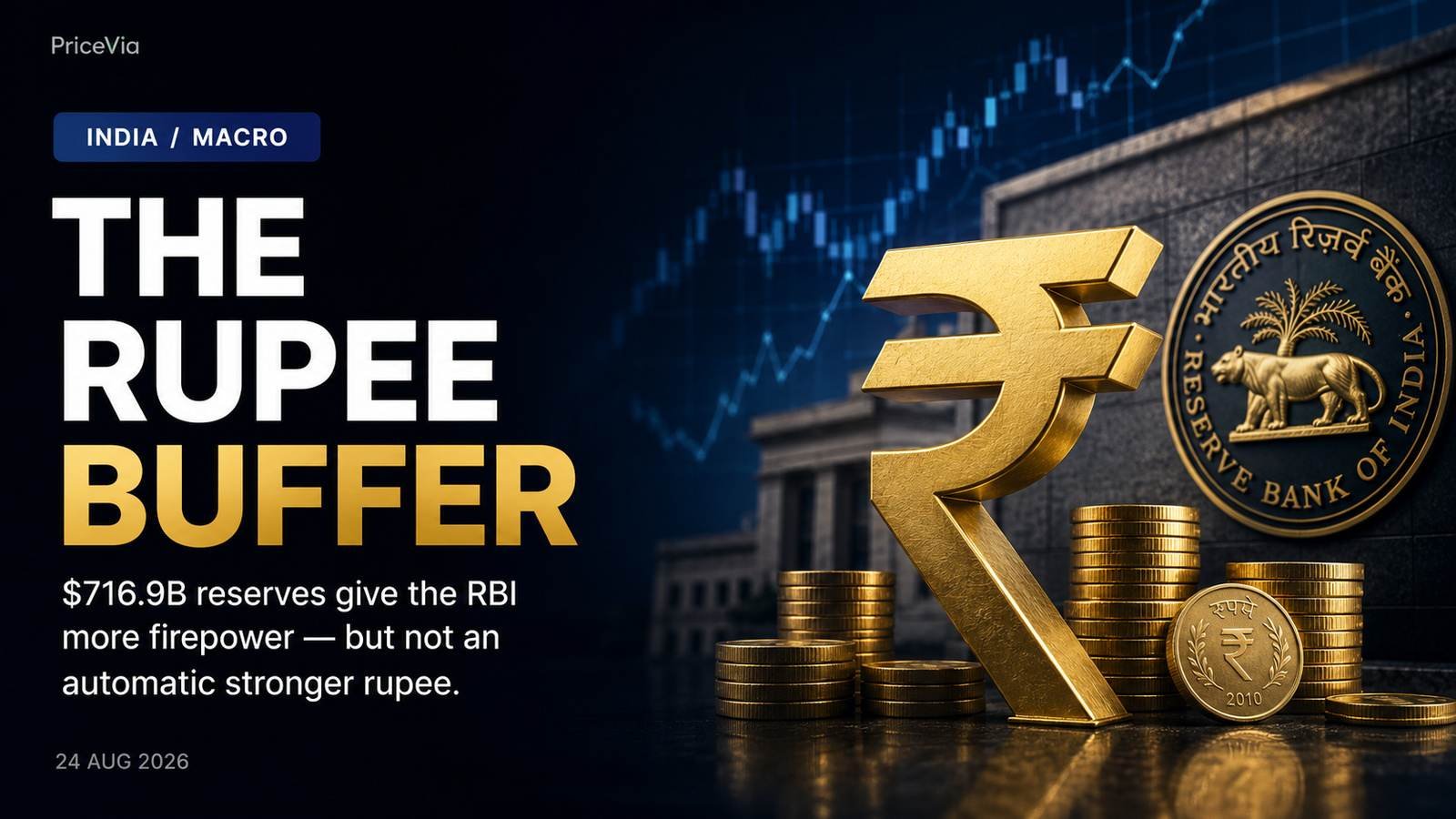
The Rupee Has a $716.9 Billion Buffer — But That Doesn't Mean It Will Get Stronger
India's reserve cushion is nearing its record high, but the RBI may prefer to turn new dollar inflows into stability rather than a much stronger rupee.
 COSTS HIT THE CUSTOMER
Tata Motors Is Raising Prices Again — India’s Auto Inflation Is Reaching Buyers
The increase is modest relative to the price of a car, but the message is larger: manufacturers are reaching the point where more of the inflation they absorbed internally is being passed to customers.