U.S. Services Are Accelerating While Factories Slow — That’s an Awkward Inflation Mix
The economy is not simply speeding up or slowing down. Services are carrying growth while factories lose momentum — a split that can keep inflation and interest-rate expectations uncomfortable.
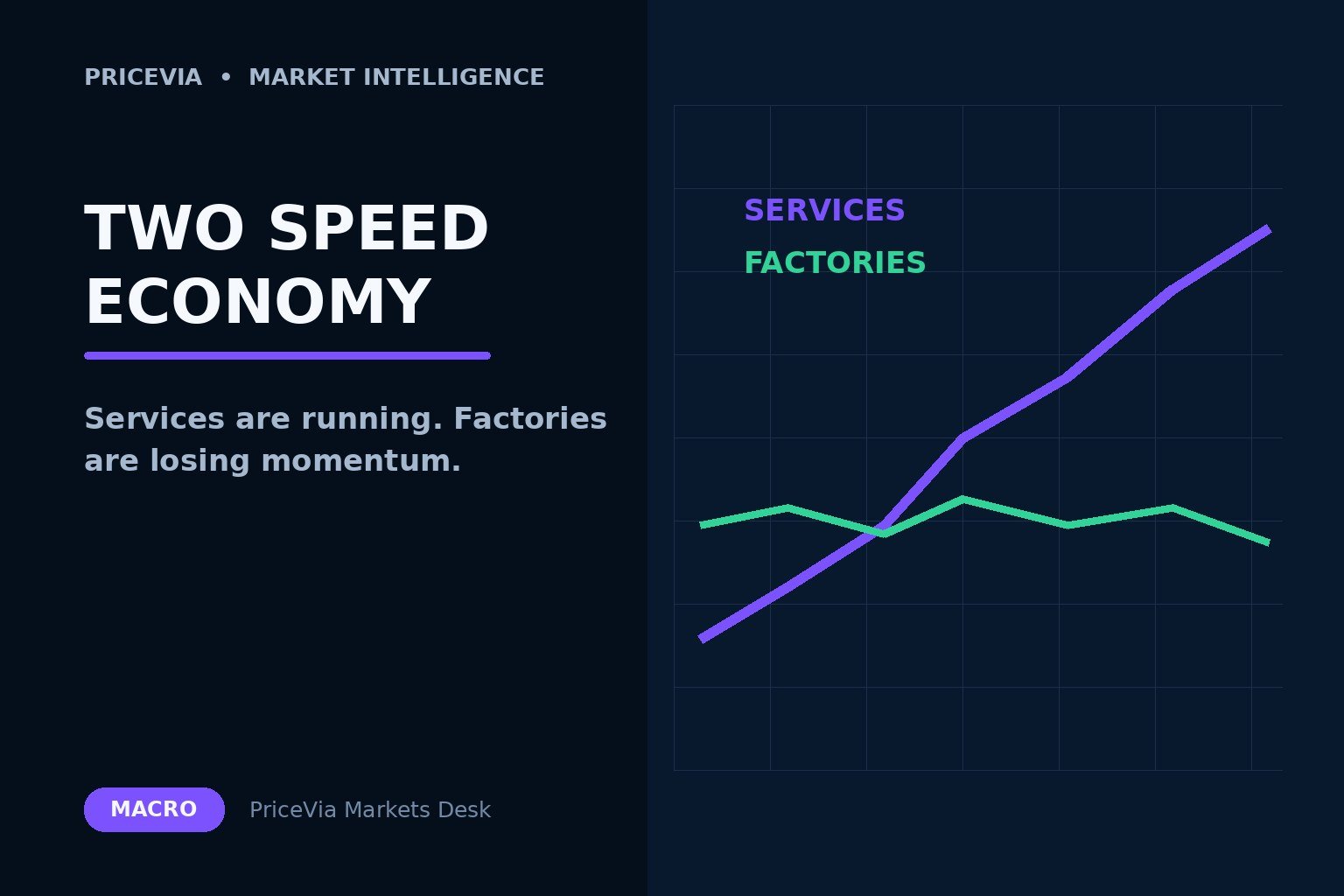
The U.S. economy is accelerating — but not evenly
August flash PMI data showed the U.S. services sector expanding at its fastest pace in nearly two years. Reuters reported that the services index rose to 56.8 from 54.6, pushing the composite output index to 56.0 even as manufacturing growth cooled.
That split matters because the service economy is much larger than manufacturing. Stronger activity in services can keep overall growth resilient even while factories slow, which makes a clean recession or slowdown narrative harder to sustain.
Factories are dealing with a different set of constraints
Manufacturing PMI eased to 53.2, while factory output growth was the weakest in 13 months. Reuters linked the slowdown to reduced inventory building and supply disruptions connected to the Iran conflict and constrained energy flows.
This is not a simple collapse in demand. Some of the weakness reflects supply and inventory behavior, which means lower factory growth can coexist with higher costs. That combination is more difficult for policymakers than a broad demand-driven slowdown.
What most people may be missing: services strength can keep inflation sticky
Services are labor-intensive and often more sensitive to wages and domestic demand than manufactured goods. When services activity and hiring accelerate, companies can retain pricing power even if goods inflation cools.
S&P Global’s survey showed price pressures easing somewhat in August, but input costs and selling prices were still rising at elevated rates. If energy costs rise again, the inflation improvement could stall before policymakers are comfortable.
Why this complicates the Federal Reserve story
Markets prefer data that point clearly toward either stronger growth or lower inflation. This report offers both resilience and risk: the economy appears to be growing faster, but the same strength can delay the return of inflation to target.
That can keep Treasury yields sensitive to every inflation release. A hotter services economy makes it harder to assume that weaker factory data alone will produce easier monetary policy.
The market reaction may depend more on prices than on headline growth
The composite PMI at 56.0 is a strong growth signal, but investors will care about whether the price components continue to cool. If services remain strong while inflation measures soften, markets can tolerate the expansion. If both demand and prices accelerate, rate expectations can reprice quickly.
Rate-sensitive growth stocks are particularly exposed because higher yields reduce the present value investors assign to future earnings. Financials can benefit from stronger activity, but only if credit quality remains solid and the yield curve behaves constructively.
The next test is whether the two-speed economy converges
Watch whether manufacturing rebounds as supply conditions normalize, or whether services eventually slow toward factories. A broad reacceleration would strengthen the growth story but could increase inflation pressure. A broad slowdown would do the opposite.
For now, the U.S. economy is sending a mixed but important message: demand remains powerful enough to keep expansion alive, while the composition of that growth is creating a more complicated path for interest rates.
- Next U.S. inflation readings, especially PCE.
- Services hiring and price components.
- Long-dated Treasury yields.
- Whether manufacturing output stabilizes as supply constraints ease.
Risk context: PMI data are survey-based early indicators and can be revised or diverge from official activity data. This is market analysis, not a forecast or investment recommendation.
Related PriceVia analysis
 NO GUIDANCE
Markets Want a Fed Signal. Kevin Warsh May Refuse to Give Them One.
The market wants a clear rate path. The new Fed chair has been moving away from forward guidance, which means every inflation print could carry more weight.
Japan’s Service Inflation Re-Accelerated to 3.6% — The BOJ Hike Case Is Getting Harder to Ignore
Japan’s business-service prices accelerated again in July, with transport and labour-heavy services showing pressure that looks broader than imported energy inflation.

Gold's Break Above $4,600 Is More Than a Safe-Haven Move — Bond Liquidity Is Driving the Rally
Gold has reached its highest level in more than three months as lower yields, a softer dollar and geopolitical risk reinforce one another.

The Dollar Is Struggling Even With Geopolitical Risk — Treasury Buybacks Changed the Trade
The dollar is failing to gain sustained traction from geopolitical stress because the bond market is increasingly driving the currency story.