The US 10-Year Yield Crossed 5% — Stocks Just Lost Their Easiest Argument
The benchmark yield returned to a level last seen in 2023 as oil, inflation, debt supply and Fed expectations collided; the key consequence is a higher hurdle rate for almost every risk asset.
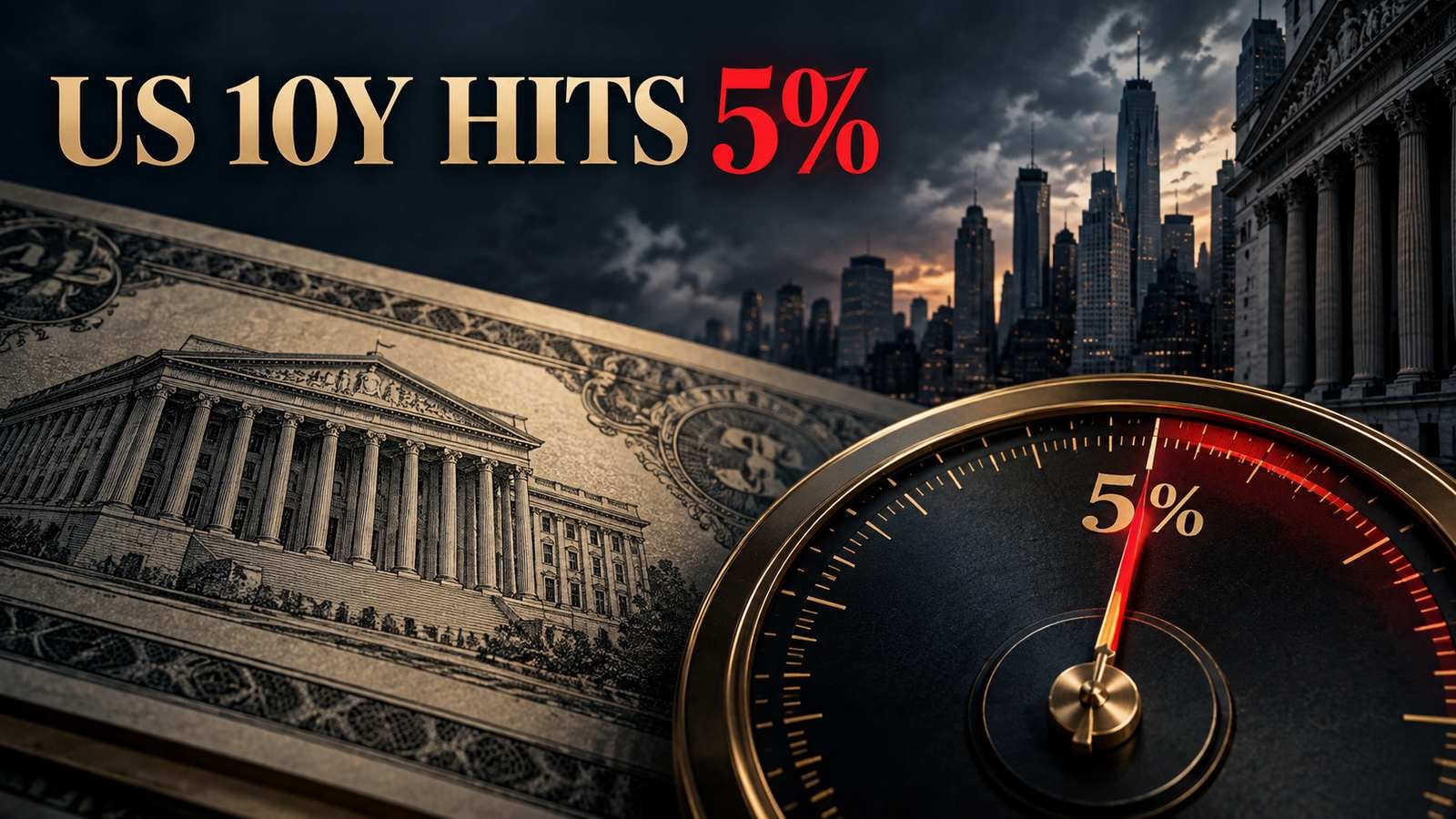
The US 10-Year Yield Crossed 5% — Stocks Just Lost Their Easiest Argument
*By PriceVia Global Markets Desk | Published September 15, 2026 | Updated September 15, 2026*
Why this matters now
The benchmark yield returned to a level last seen in 2023 as oil, inflation, debt supply and Fed expectations collided; the key consequence is a higher hurdle rate for almost every risk asset.
Key points
- The US 10-year Treasury yield moved above 5%, its highest since October 2023. - Oil-driven inflation concern, heavy borrowing and expectations of tighter Federal Reserve policy contributed to the selloff. - A 5% risk-free benchmark does not guarantee an equity decline, but it raises mortgage, corporate and valuation discount rates across the economy.
The numbers
| Metric | Value | Context | |---|---:|---| | 10-year yield | Above 5% | First time since 2023 | | Recent level | ~5.01% | Intraday reference | | Fed meeting | September 15–16 | Policy decision due | | Expected hike | 25 bp | Market base case | | Fed target after hike | 3.75%–4.00% | Economist forecast | | Oil reference | Above $100 | Inflation pressure |
What happened — confirmed facts
Benchmark 10-year Treasury yields climbed above 5% on September 14, a level not sustained for long in almost two decades and last touched in October 2023. [S1, S2] The move followed higher oil prices, renewed inflation pressure and expectations of a Federal Reserve rate increase. Heavy government and corporate debt issuance also increased the amount of duration investors must absorb. [S1, S3]
What everyone is watching
The market is watching whether 5% becomes a floor or a brief overshoot. A stable move above the threshold would feed into mortgages, corporate borrowing, municipal finance and equity discount rates. The Federal Reserve’s projections matter more than one quarter-point decision. Investors need to know whether policymakers see an isolated response to oil or a renewed tightening cycle.
What the market may be missing — PriceVia analysis
PriceVia analysis: the equity threat is relative value. When a government bond offers 5%, expensive stocks must deliver more credible growth to justify earnings risk and duration. The yield also tightens financial conditions without a central-bank announcement. Refinancing calendars can transmit the shock gradually as households and companies replace low-cost debt.
Positive case
Oil eases, inflation expectations stabilise and strong Treasury demand pulls yields back. Equity cash flows remain resilient and the 5% breach proves temporary rather than a new regime.
Downside case
Yields hold above 5%, term premium rises and refinancing costs spread through housing and corporate credit. Long-duration equities and leveraged companies face the largest valuation pressure.
What would change the story
Watch the Fed statement, inflation expectations, Treasury auctions, oil prices and mortgage rates. Repeated strong auction demand and a decisive move below 5% would soften the risk.
Related stocks and themes
US Treasuries, S&P 500, Nasdaq, banks, housing, utilities, high-yield credit, gold, the dollar and global sovereign bonds.
How to read it
Recalculate discount rates and refinancing costs instead of trading the round number alone. The duration of the move matters more than the first breach.
Reader checklist
- Confirm fed guidance in a primary disclosure before changing the thesis. - Compare treasury auctions with the headline narrative; they may move in different directions. - Reassess after new information on mortgage rates rather than treating the first report as a completed outcome.
PriceVia View
Five percent is not magical, but it changes the conversation. The safest asset in global finance now competes harder for capital with every optimistic valuation.
Sources and timestamps
- [S1 — Reuters: US 10-year yield reaches 5%](https://www.reuters.com/business/us-10-year-yields-reach-5-highest-since-2023-2026-09-14/) — published 2026-09-14; accessed 2026-09-15T13:15:00+05:30 - [S2 — US Treasury: daily yield curve rates](https://home.treasury.gov/resource-center/data-chart-center/interest-rates) — published 2026-09-15; accessed 2026-09-15T13:15:00+05:30 - [S3 — Federal Reserve: FOMC information](https://www.federalreserve.gov/monetarypolicy/fomc.htm) — published 2026-09-15; accessed 2026-09-15T13:15:00+05:30 - [S4 — Financial Times: Treasury yield at 5%](https://www.ft.com/content/06cb850d-089a-4318-88d7-a410e9766b89) — published 2026-09-14; accessed 2026-09-15T13:15:00+05:30
Visual disclosure
Hero visual created specifically for this article. Thumbnail text: “US 10Y HITS 5%”. It is an editorial illustration, not a market-data, legal, clinical or regulatory screenshot.
Market-risk disclaimer
This article is for market education and information only. It is not investment advice, a recommendation or a promise of returns. Market prices, policy decisions, deal terms, clinical results and forecasts can change. Verify the latest primary disclosures and assess suitability and risk independently.
- Fed guidance
- Treasury auctions
- Mortgage rates
Risk context: This article is for market education and information only. It is not investment advice, a recommendation or a promise of returns. Market prices, policy decisions, deal terms, clinical results and forecasts can change. Verify the latest primary disclosures and assess suitability and risk independently.
- reuters.com2026-09-14
- home.treasury.gov2026-09-15
- federalreserve.gov2026-09-15
- ft.com2026-09-14
Related PriceVia analysis
Chinese Investors Paid a 24% Premium for Wall Street — That Is Demand, Not Value
A $6.8 billion quota increase unleashed pent-up demand for U.S. technology funds, but extreme ETF premiums mean some buyers are paying far more than the assets are worth.

BRICS Wants to Rewrite Global Finance — Payments Are the First Real Test
Finance ministers demanded a bigger emerging-market voice and faster, cheaper cross-border payments; turning a joint statement into interoperable infrastructure is the harder step.

ByteDance Borrowed $29.6 Billion Without Collateral — Nearly 30 Banks Wanted In
The three-year facility grew from a $20 billion target after overwhelming lender demand, with Chinese banks providing more than 60% and overseas AI infrastructure absorbing much of the capital.

One Refinery, a $47 Billion Valuation: Africa’s Biggest IPO Faces Its Hardest Question
Nigeria approved a 4.1-billion-share offer that could raise $1.63 billion, but the implied valuation towers over listed refining peers while detailed financial statements remain limited.